
Resort Interior Design in Thailand: Creating World-Class Destinations
Thailand offers resort designers something unusually powerful.
Not simply beautiful scenery.
But a combination of landscape, climate, craft, hospitality culture, local fabrication, and an established tourism environment that gives design something real to respond to.
A beachfront property in Phuket should not feel like a resort transplanted from another coastline.
A riverside retreat should not behave like a mountain destination.
A tropical villa resort should not simply borrow the visual language of “island luxury” from an international mood board.
For international developers, this is what makes Resort Interior Design in Thailand particularly interesting.
Thailand should not become the backdrop to a resort concept. It should become one of the forces that creates the concept.
The strongest resorts feel difficult to separate from where they stand.
Landscape influences architecture.
Climate influences materials.
Craft influences detail.
Culture influences hospitality.
And interior design connects those conditions into one experience.
Why Thailand Is Such a Strong Resort Design Market
Thailand contains remarkably different resort contexts within one country.
Coastlines.
Islands.
Mountains.
Forests.
Rivers.
Dense urban environments.
Agricultural landscapes.
Tropical gardens.
That variety immediately prevents resort design from having one correct visual language.
A beachfront resort in Phuket asks different questions from a forest retreat.
A riverside property near Bangkok has another relationship with water and urban movement.
A hillside destination in the north introduces different views, climate, material opportunities, and architectural traditions.
The diversity of Thailand is a gift to designers — and a trap for anyone tempted to use the same resort formula everywhere.
The location has to become part of the brief.
Not simply the address.
Landscape Should Influence the Resort Before Style Does
Resort guests often travel precisely because they want to experience somewhere different from everyday life.
That means the site is not simply land on which buildings happen to sit.
It is part of the product.
The first design questions should therefore include:
What is already extraordinary here?
What should remain untouched?
Where should guests feel exposed to the landscape?
Where should they feel protected from it?
What should be visible immediately?
What should be discovered later?
Where does the sun rise?
How does rain move across the site?
Where is the wind?
What sounds belong here?
Which view deserves architectural attention — and which does not?
A strong resort interior should not compete with the destination. It should teach guests how to experience it.
That may mean framing a view.
Creating a shaded threshold.
Lowering the architecture so landscape becomes dominant.
Or making one interior deliberately inward-looking so the next moment of nature becomes more powerful.
Thailand’s Craft Ecosystem Creates Design Opportunity
Thailand has long-standing capabilities across areas such as:
timber,
stone,
metalwork,
weaving,
ceramics,
furniture,
decorative finishes,
textiles,
and specialist fabrication.
For resort interior design, this can create opportunities for project-specific work that extends beyond selecting products from an international catalogue.
A screen can be developed with a maker.
A weaving method may become an architectural surface.
Furniture can respond to exact spatial conditions.
Metalwork can become part of lighting.
Ceramics can move from decoration into architecture.
But local craft should not be inserted simply to prove that a project is in Thailand.
Craft becomes valuable when the technique, material, or maker contributes to the identity of the resort — not when it becomes cultural decoration.
The relationship between designer and maker can also deepen the project.
The designer brings intention.
The maker brings knowledge of material and process.
The strongest result often appears when both are allowed to influence the answer.
Local Craft Does Not Require a Traditional Aesthetic
A contemporary resort can use Thai craft without looking traditional.
That distinction matters.
A weaving technique can become highly geometric.
A familiar material can appear at an unfamiliar scale.
A traditional method of making can produce a completely contemporary piece.
Local stone can be treated with unusual precision.
Ceramics can become modular architectural components.
Regional craft can influence detail without becoming obvious symbolism.
Thai soul does not require Thai decoration.
A project can speak an international design language while still being deeply connected to the place where it was made.
That is often more sophisticated than reproducing recognisable motifs.
Climate Is Part of the Concept, Not a Technical Problem Added Later
Tropical design begins with conditions.
Heat.
Humidity.
Strong sunlight.
Heavy rain.
Salt air in coastal environments.
Rapid transitions between exterior and air-conditioned spaces.
These conditions affect:
materials,
furniture,
metal finishes,
lighting,
ventilation,
thresholds,
landscape,
maintenance,
and the relationship between interior and exterior.
A material that performs beautifully inside an urban hotel may behave very differently beside the sea.
An exterior chair needs another level of consideration from one inside an air-conditioned lobby.
A dramatic glazed wall may become uncomfortable if solar exposure is ignored.
Climate therefore needs to enter the concept from the beginning.
At ANANN Villas – Phuket, the relationship between landscape, privacy, architecture, and tropical living demonstrates why environment cannot be separated from the experience of the residence.
Likewise, projects such as Baan Suan – Nakhon Si Thammarat illustrate how nature can become part of everyday spatial experience rather than decoration surrounding a building.
The best tropical design does not fight the climate everywhere. It decides intelligently when to protect people from it — and when to let them experience it.
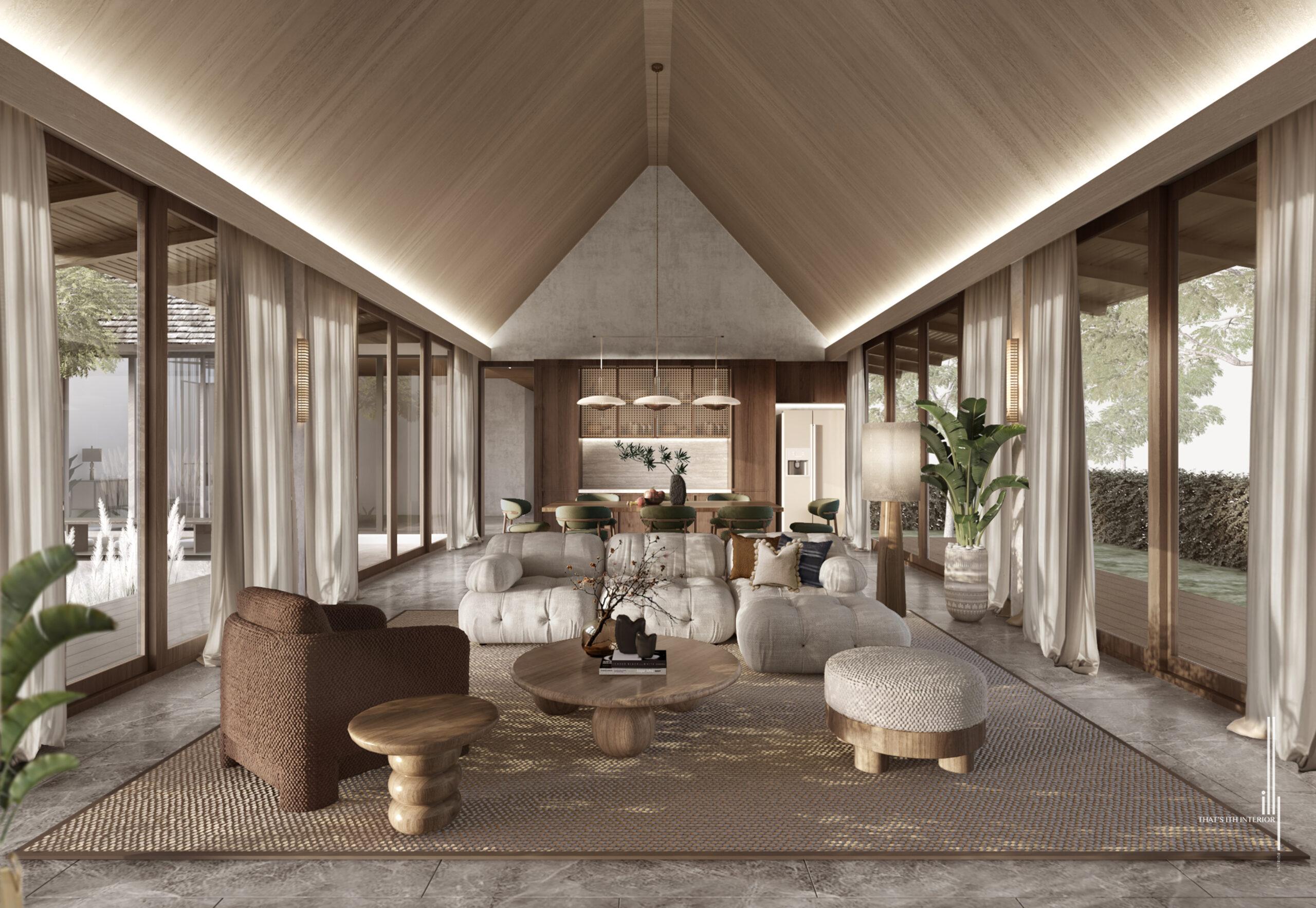
Shade Can Become Architecture
In tropical destinations, shade is more than environmental protection.
It can become one of the defining spatial experiences.
A deep veranda.
A covered walkway.
A perforated screen.
A shaded courtyard.
A roof extending far beyond the enclosed room.
A transition where sunlight gradually softens before the guest enters.
These moves can influence atmosphere as strongly as furniture or materials.
Shade also creates rhythm.
Bright.
Dark.
Cool.
Warm.
Open.
Protected.
In tropical resort design, comfort and emotion often come from the same architectural decision.
A shaded threshold can solve climate and create memory simultaneously.
That is far more interesting than treating environmental performance and guest experience as unrelated disciplines.
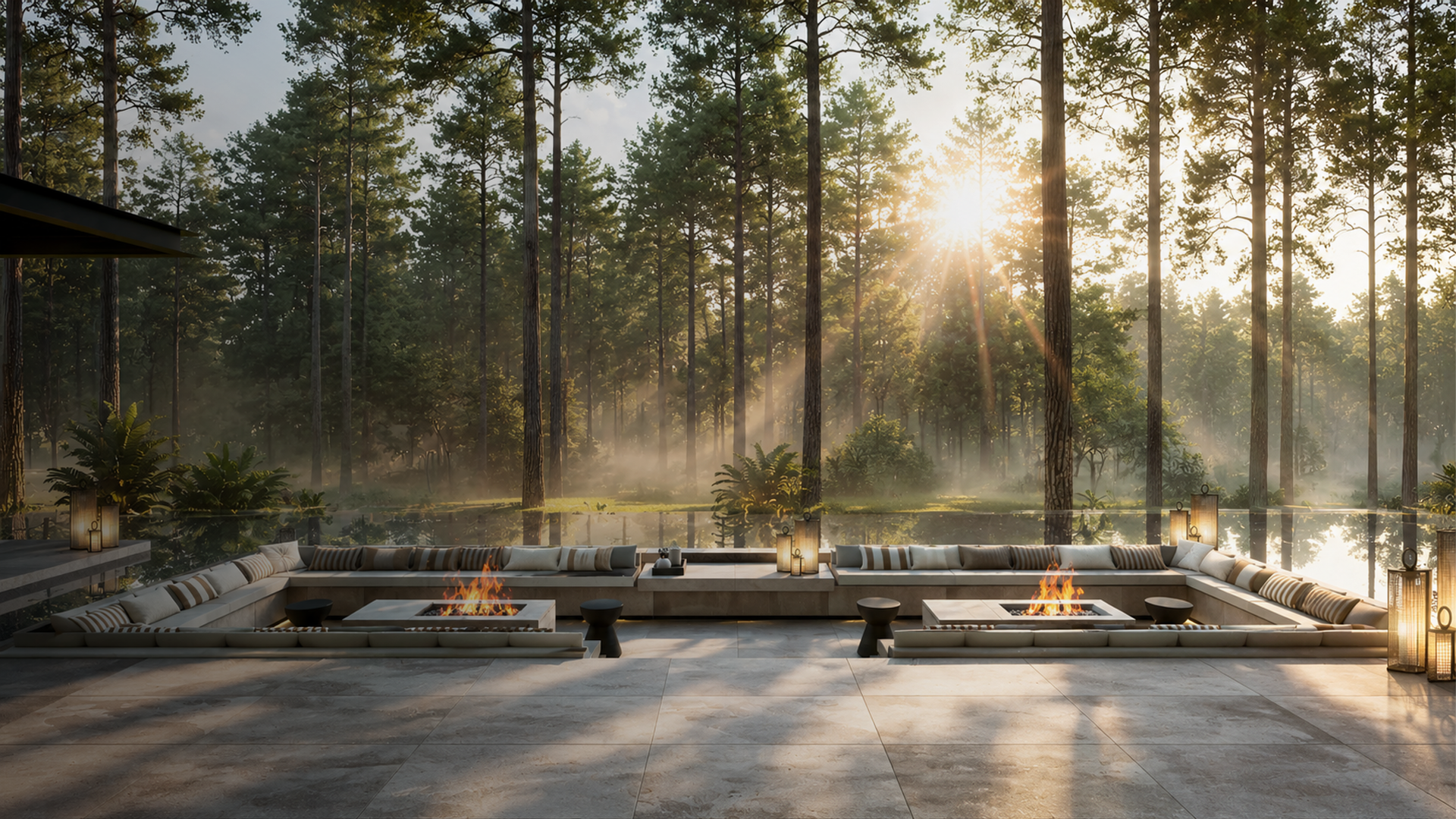
Indoor and Outdoor Should Feel Like One Experience
In many tropical resorts, the most memorable “room” may not be fully indoors.
A veranda.
Pool terrace.
Courtyard.
Outdoor bathroom.
Shaded lounge.
Garden pavilion.
The threshold between inside and outside therefore deserves as much design attention as either environment on its own.
Where does air-conditioning end?
What happens under rain?
How does flooring transition?
Where do insects become a concern?
How does furniture perform?
Where does privacy change?
What happens at night?
How does lighting extend the architecture into the landscape?
Indoor-outdoor living becomes convincing when the boundary itself is designed.
Simply installing large glass doors is not enough.
The guest should experience architecture, interior, and landscape as one continuous environment.
Resort Design Should Let Nature Change Across the Day
A resort is experienced over time.
Morning light.
Midday heat.
Afternoon rain.
Sunset.
Night.
Landscape changes.
Sound changes.
Temperature changes.
A successful resort design acknowledges those shifts.
A breakfast terrace may feel completely different at dinner.
A swimming pool changes character after dark.
A room facing east behaves differently in the morning from one facing west.
A courtyard that feels calm during daylight may become theatrical at night.
A resort should not have only one visual identity. It should know how to change as the destination changes around it.
Lighting is especially important here.
The goal is not to replace nature after sunset.
It is to decide which parts of the resort deserve another life at night.
The Guestroom Should Be Designed as Temporary Private Living
A resort guestroom is not simply somewhere to sleep.
Particularly at the luxury end, guests may spend significant portions of the day there.
They may:
work,
eat,
read,
rest,
swim,
bathe,
entertain,
or withdraw completely from the public resort.
Villas make this even more important.
A resort villa behaves more like a temporary private residence.
Privacy.
Storage.
Luggage.
Bathing.
Outdoor living.
Pool relationships.
Lighting.
Furniture comfort.
Service access.
Technology.
All influence the experience.
The guest should feel that the room understands how they want to live for several days — not merely where they should sleep at night.
This is one of the important differences between designing a resort and designing only for first impressions.
Privacy Is Part of Tropical Luxury
Resort landscapes often encourage openness.
Large windows.
Pools.
Terraces.
Gardens.
Outdoor bathrooms.
But luxury also depends on control.
Can guests enjoy landscape without constantly being visible?
Can villas remain open without overlooking each other?
Can staff provide service without disturbing privacy?
Can public and private circulation coexist?
A strong resort plan creates degrees of privacy rather than simply open versus closed.
Public.
Social.
Semi-private.
Private.
Retreat.
Luxury is not simply having more space. It is having greater control over when to participate and when to withdraw.
Landscape, screens, level changes, planting, orientation, and architecture can all contribute to this without making the resort feel defensive.
Materials Have to Earn Their Place
Using local materials does not automatically create sense of place.
Nor does using expensive materials automatically create luxury.
The more useful question is:
Why this material, here?
A local stone may connect the project to geology.
Timber might create warmth and improve the relationship with surrounding landscape.
A woven element may introduce craft and acoustic softness simultaneously.
A metal finish may need to resist coastal conditions.
A floor may be chosen partly because guests frequently move between pool and interior.
Materials operate visually, physically, technically, and emotionally.
The strongest material palette is not the one containing the most impressive finishes. It is the one in which every material contributes something specific to the resort.
That specificity can be far more memorable than abundance.
Beachfront Resort Design Requires Another Level of Material Judgment
Coastal environments can be beautiful and unforgiving.
Salt.
Moisture.
Intense sunlight.
Wind.
Sand.
Frequent wet-dry cycles.
These conditions can accelerate deterioration.
Metal corrodes.
Fabrics fade.
Timber changes.
Hardware suffers.
Exterior furniture receives intense exposure.
A Luxury Beachfront Resort Design in Thailand therefore needs material selection to consider more than opening-day photography.
How will the finish look after several rainy seasons?
Can it be repaired?
Can parts be replaced?
How easily can maintenance teams access it?
Will natural ageing improve the material — or make it appear neglected?
A resort should be designed for the thousandth guest, not only the photographer arriving before the first one.
Longevity is part of luxury.
Thailand Is Not One Resort Context
Treating “Thailand” as one design identity is one of the easiest mistakes to make.
Phuket is not Bangkok.
Bangkok is not Chiang Mai.
A southern island is not a northern hillside.
Even within the same region, one site may behave completely differently from another.
Orientation changes.
Topography changes.
Vegetation changes.
Views change.
Nearby culture changes.
Guest expectations change.
The business model may change too.
A resort designer with real Thailand experience should not possess a Thai resort formula. They should possess the ability to read different Thai sites differently.
Portfolio diversity therefore matters.
If every resort from the same studio looks almost identical, the studio may be expressing itself more strongly than the destinations it was hired to interpret.
The Risk of Treating Thailand as a Beautiful Backdrop
An international developer can arrive with a highly developed design direction already established elsewhere.
Sometimes that approach works.
But there is a risk.
Thailand becomes little more than scenery surrounding an international concept.
The result may be polished.
It may be luxurious.
But it may also feel strangely transferable.
Move the same property to Bali, Mexico, or another tropical destination and little would need to change.
That is a warning sign.
A strong resort should lose something essential if removed from its site.
Not because it relies on literal cultural symbolism.
Because landscape, climate, craft, architecture, and local intelligence have influenced the design deeply enough that the answer belongs where it is.
International Does Not Mean Neutral
International luxury is sometimes interpreted as cultural reduction.
Remove anything too local.
Use globally familiar furniture.
Choose a safe material palette.
Create something broadly acceptable to everyone.
The intention is understandable.
The result can become anonymous.
Well-travelled guests already encounter sophisticated hotels and resorts around the world.
What can distinguish one destination is not simply a higher level of generic luxury.
It is specificity.
Projects such as The Title Villa Kirara – Phuket demonstrate the opportunity to create contemporary tropical luxury without reducing the design to a generic international resort language.
International sophistication and local identity are not opposites.
The strongest luxury resorts often possess both.
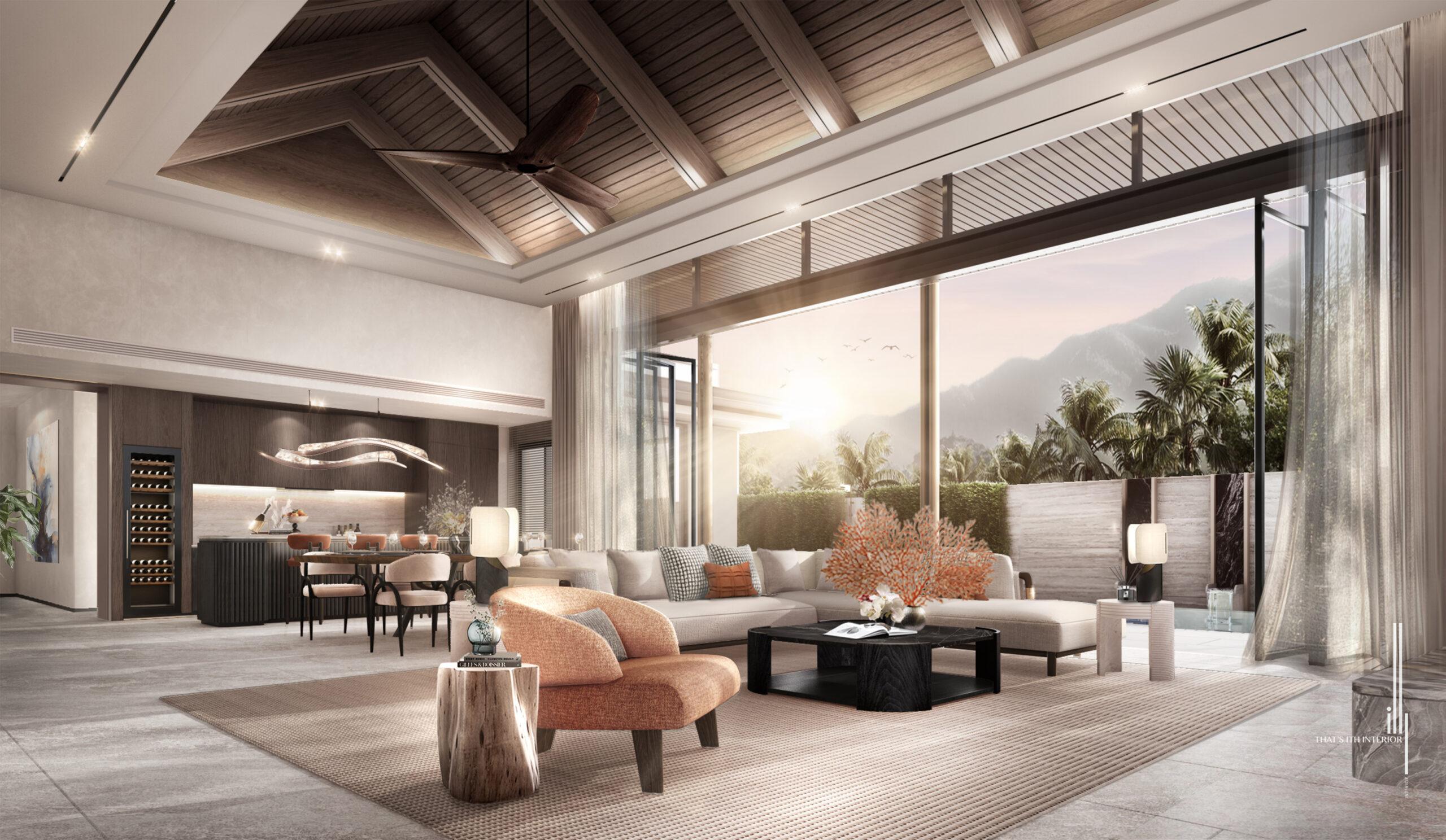
Local Knowledge Should Expand Ambition, Not Restrict It
For international developers, appointing a designer with local experience should not mean lowering ambition to accommodate local limitations.
The opposite can happen.
Knowing the local making ecosystem can reveal opportunities that somebody outside the market may not know exist.
A particular workshop may produce extraordinary metalwork.
A craft process may become an architectural feature.
Local furniture fabrication may make project-specific pieces viable.
Regional materials may replace an imported solution more convincingly.
A local maker may suggest a better construction method.
Local intelligence is valuable when it increases the number of intelligent design options available to the project.
It should not simply become a list of practical constraints.
The Right Resort Designer Bridges Global Expectation and Local Reality
International resort developments frequently involve multiple parties.
Owner.
Operator.
Hotel brand.
Architect.
Interior designer.
Landscape architect.
Lighting designer.
Kitchen consultant.
MEP engineers.
Project manager.
Contractor.
Local suppliers.
International suppliers.
The design partner needs to communicate across these groups while protecting the identity of the project.
A Luxury Resort Interior Design Firm in Thailand working with international developers therefore needs two kinds of fluency:
global design expectations,
and local execution knowledge.
Neither is enough on its own.
International ambition without local understanding can become difficult to execute.
Local capability without global perspective may not meet the positioning of an international luxury property.
The value lies in the bridge between them.
Landscape Architecture and Interior Design Should Not Behave Separately
A resort is one of the project types where boundaries between disciplines become particularly visible to guests.
The lobby opens toward landscape.
Guestrooms frame views.
Restaurants extend onto terraces.
Pools connect architecture and nature.
Paths become part of arrival.
Courtyards influence interiors.
Planting creates privacy.
If landscape and interior design develop separately for too long, the guest may experience the seams.
The guest should experience one resort — not a collection of consultant packages.
That does not mean one team needs to design everything.
It means the teams need enough collaboration for the boundaries between their work to feel intentional.
Resort design becomes much stronger when architecture, interior, and landscape influence one another early.
Sustainability Should Begin With the Site
Resorts often market their relationship with landscape.
Ocean.
Forest.
Mountain.
River.
Nature.
That creates responsibility.
Sustainability cannot be reduced to a list of “green” materials added after the core design has already been established.
More fundamental questions matter.
What already exists on the site?
What can remain?
How much intervention is necessary?
Can local materials reduce unnecessary transport?
Will the selected materials last?
Can components be repaired?
How does the architecture respond to sun and shade?
Can landscape strategy support comfort?
What will the project require to maintain?
The most credible environmental strategy is often the one embedded in the original design logic rather than added as an environmental narrative later.
Longevity also matters.
A resort that requires premature refurbishment because the original materials or design language cannot survive real operation has created another kind of waste.
Sustainability and Guest Experience Can Support Each Other
Environmental intelligence does not need to make a resort feel worthy or instructional.
Often, the same decisions improve experience.
Shade makes outdoor life more comfortable.
Existing trees create character.
Natural materials add tactility.
Local craft adds specificity.
Good daylight reduces dependence on artificial lighting while changing atmosphere.
Cross ventilation may improve transitional spaces where conditions allow.
Landscape can support privacy and microclimate simultaneously.
Some of the most sustainable decisions are powerful precisely because guests experience them as good design rather than environmental features.
The environmental performance and emotional experience do not need to compete.
Resorts Need to Be Designed for Operations, Not Only Escape
A resort may feel effortless to the guest.
Behind that feeling is considerable operational complexity.
Housekeeping.
Luggage.
Food service.
Maintenance.
Pool servicing.
Laundry.
Deliveries.
Staff circulation.
Back-of-house functions.
Technology.
Security.
All have spatial consequences.
A beautiful guest journey can be compromised quickly when service routes repeatedly cross it.
A dramatic material can become a problem if maintenance is unrealistic.
A remote villa can become operationally inefficient if service was not considered early.
The guest should experience escape because the operational complexity has been solved — not because it was ignored.
Operational intelligence and emotional design support each other.
The First Impression Matters. So Does the Hundredth.
Resorts are unusual because guests may remain inside the same environment for several days.
They repeatedly walk the same pathways.
Return to the same room.
Use the same breakfast restaurant.
Pass through the same lobby.
Sit by the same pool.
A design that relies only on immediate spectacle may lose power quickly.
The resort needs sensory endurance.
Comfort.
Variety.
Discovery.
Changing light.
Different levels of social energy.
Moments of retreat.
Details that reveal themselves slowly.
The first impression may persuade someone that the resort is beautiful. Repeated experience determines whether they actually want to remain there.
This is why resort design has to think beyond the hero image.
How Should International Developers Evaluate a Resort Interior Designer in Thailand?
A strong portfolio is useful.
But developers should look beyond visual impact.
1. Do they have genuine tropical or resort experience?
Hospitality experience alone is not always enough.
Resorts have particular relationships with landscape, climate, privacy, indoor-outdoor living, and extended guest stay.
2. Do they understand indoor-outdoor design?
Look at thresholds, terraces, courtyards, pool relationships, landscape integration, and semi-outdoor environments.
Not just guestrooms.
3. Does the portfolio respond differently to different sites?
Different destinations should produce different answers.
4. Can the studio work with local makers?
Ask how bespoke work is developed, fabricated, sampled, and coordinated.
5. Do they understand material performance?
Particularly for tropical and coastal environments.
6. Can they collaborate with landscape architects and other consultants?
Resort interior design rarely succeeds in isolation.
7. Do they show built work?
Renderings demonstrate imagination.
Built projects demonstrate whether the design survived coordination and execution.
8. Can they explain why?
Why this material?
Why this planning?
Why this degree of openness?
Why this relationship with landscape?
Why this project belongs here?
A strong resort designer should not simply show a beautiful destination. They should be able to explain why the destination produced this particular design.
What Should International Developers Understand Before Starting a Resort in Thailand?
Do not arrive with every visual answer already fixed.
Bring ambition.
Bring positioning.
Bring operational requirements.
Bring brand standards where relevant.
But leave enough room for the site and local intelligence to change the design.
Appoint key design disciplines early enough for architecture, interior, and landscape to influence one another.
Understand which materials can perform locally.
Investigate local fabrication before assuming everything important must be imported.
Define consultant responsibilities clearly.
And allow sufficient time for bespoke development, sampling, mock-ups, coordination, and procurement.
The greatest advantage of designing in Thailand is not that the country can reproduce an international idea efficiently.
It is that Thailand can contribute something to the idea that was not available before the project arrived.
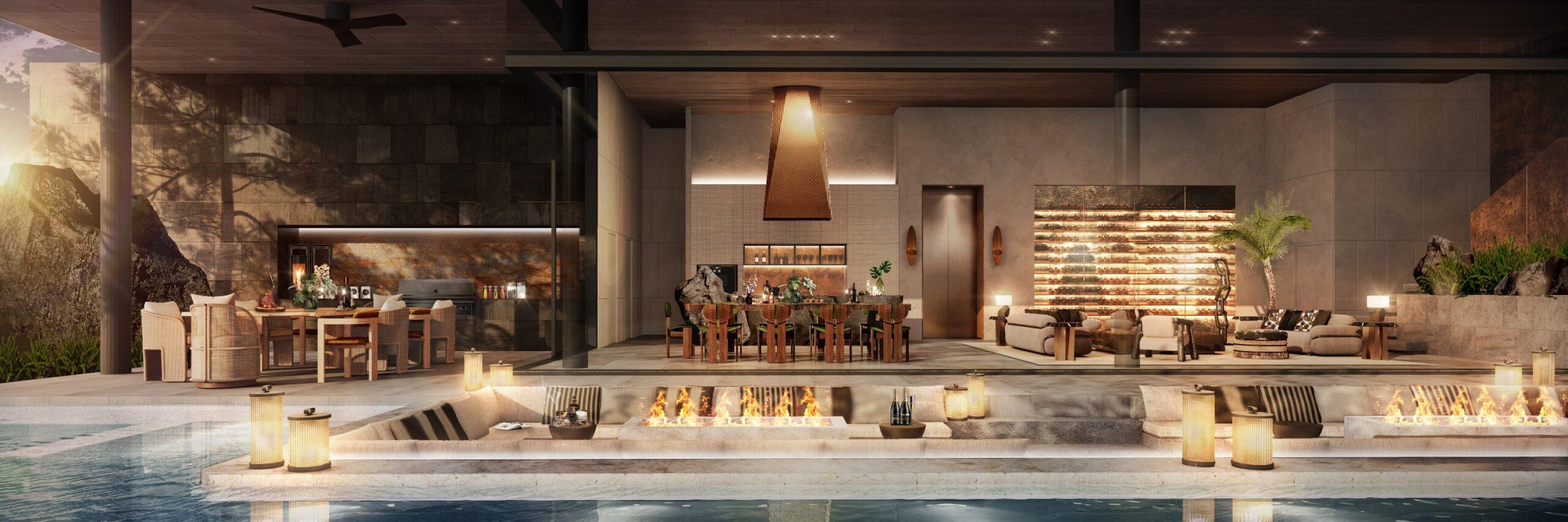
That’s ITH’s Perspective on Resort Interior Design in Thailand
At That’s ITH Interior, we do not see Thailand as a backdrop for resort design.
We see it as a design partner.
The site has an opinion.
The climate has an opinion.
The landscape has an opinion.
The available craft has an opinion.
The guest has expectations.
The operator has realities.
Our role is to listen to all of them before deciding what the resort should look like.
That is why we do not begin with a recognisable resort style.
A project in Phuket should not automatically look like another project elsewhere in Thailand.
A forest environment should not inherit the visual language of a beachfront property.
A private villa resort should not behave like a large hotel.
The answer changes because the place changes.
For us, Fearless Luxury in resort design means having enough confidence to let the identity of the destination influence the project more strongly than a predetermined image of what luxury is supposed to look like.
Sometimes that produces drama.
Sometimes stillness.
Sometimes highly crafted interiors.
Sometimes the most important design decision is allowing nature to remain the protagonist.
Projects such as ANANN Villas – Phuket, The Title Villa Kirara – Phuket, and Baan Suan – Nakhon Si Thammarat demonstrate different relationships between tropical living, landscape, architecture, privacy, and interior identity.
They do not need to look the same.
The consistency is in the judgment.
And the ultimate ambition is simple:
to create resorts that could not have belonged anywhere else.
Explore That’s ITH projects to discover our work across resort, hospitality, residential, restaurant, and destination environments.
Planning a Resort Project in Thailand?
The strongest resort concepts develop when site, architecture, landscape, operations, interiors, and hospitality experience can influence one another before the design direction has already become fixed.
Led by founder and designer ITH PALACH, whose design career spans more than 25 years, That’s ITH Interior is a Bangkok-based interior design studio working across hospitality, resort, residential, restaurant, and commercial projects in Thailand and international markets.
We collaborate with developers, owners, operators, architects, landscape designers, lighting consultants, contractors, makers, and multidisciplinary teams to translate site, climate, identity, operations, and ambition into hospitality environments specific to their destinations.
Contact That’s ITH Interior to discuss your next resort or hospitality development in Thailand.
Frequently Asked Questions
What makes resort interior design in Thailand distinctive?
Thailand combines diverse tropical landscapes, climate conditions, craft capabilities, local fabrication, and a mature hospitality environment.
The strongest resort design uses these conditions to create a project specific to its site rather than simply applying a generic tropical-luxury aesthetic.
What should international developers look for in a resort interior designer in Thailand?
Look for relevant built resort or tropical hospitality experience, strong indoor-outdoor thinking, understanding of climate and material performance, collaboration with landscape and technical consultants, local fabrication knowledge, and a portfolio showing different responses to different destinations.
How does tropical climate affect resort interior design?
Heat, humidity, strong sunlight, rain, and coastal exposure can influence material selection, shading, ventilation, thresholds, furniture, lighting, exterior spaces, maintenance, and the relationship between architecture and landscape.
Climate should influence design from the beginning rather than being treated only as a technical issue later.
What is different about luxury beachfront resort design in Thailand?
Beachfront resorts need to respond to salt air, sunlight, moisture, wind, sand, and intense outdoor use.
Material durability, corrosion resistance, shading, indoor-outdoor transitions, privacy, landscape integration, and long-term maintenance all become particularly important.
Does a luxury resort in Thailand need to look traditionally Thai?
No.
Thai identity can appear through craft, material, spatial thinking, landscape, light, thresholds, and contemporary reinterpretations of local making traditions rather than literal cultural motifs.
The objective is to make the project belong to Thailand, not necessarily to make it look traditionally Thai.
Why is indoor-outdoor design important in Thai resorts?
Tropical resort guests often experience terraces, pools, gardens, courtyards, outdoor bathrooms, verandas, and semi-open spaces as integral parts of the stay.
The boundary between interior and landscape therefore needs to be designed as carefully as the enclosed rooms themselves.
Why is local craft important in luxury resort interior design?
Local craft and fabrication can create project-specific furniture, lighting, screens, surfaces, joinery, ceramics, textiles, and details that strengthen the resort’s connection to place.
Their value comes from relevance to the concept, not simply from being locally made.
Do international developers need a local interior designer for a Thailand resort?
A local designer is not automatically required in every consultant structure, but strong knowledge of Thai climate, fabrication, contractors, materials, craft, procurement, and local project conditions can be a significant advantage.
For international projects, the most useful partner can often combine global design expectations with local execution intelligence.
How should a resort respond to different regions of Thailand?
Each site should be read individually.
A Phuket beachfront resort, a riverside property, a northern hillside retreat, and a forest destination have different climates, landscapes, cultural contexts, guest expectations, and architectural opportunities.
There should not be one universal Thai resort formula.
How important is landscape architecture to resort interior design?
Extremely important.
Guestrooms, restaurants, pools, terraces, paths, views, privacy, courtyards, and public spaces often connect directly to landscape.
Architecture, interior design, and landscape should therefore influence one another early enough that guests experience one destination rather than separate consultant packages.
How can resort design become more sustainable?
Sustainability can involve retaining existing landscape where possible, climate-responsive design, durable materials, local sourcing where appropriate, repairability, reduced unnecessary intervention, long-term maintenance, and creating spaces that remain relevant rather than requiring premature replacement.
Environmental thinking is strongest when it forms part of the original design logic.
What makes a resort feel authentic to Thailand without becoming themed?
Authenticity comes from understanding place rather than applying symbols of place.
Climate, landscape, craft, local materials, cultural behaviour, spatial traditions, and methods of making can all influence contemporary design without turning the resort into a literal cultural theme.
When should a resort interior designer join the project?
Ideally during early architecture and planning.
Resort interiors interact closely with landscape, room planning, views, pools, terraces, lighting, services, furniture, materials, and operational circulation.
Early collaboration allows these relationships to develop as one coherent experience.
What makes a resort timeless?
A resort is more likely to age well when its identity grows from site, proportion, climate, material, craft, behaviour, and guest experience rather than depending mainly on a short-lived visual movement.
Timelessness does not require neutrality.
A resort can be bold and still endure when its strongest decisions have deeper reasons for existing.
What is the most important principle in resort interior design in Thailand?
Perhaps this:
Do not ask how to make the resort look like Thailand.
Ask:
“What can this particular place teach us that should change the design?”
When the answer genuinely influences architecture, interior, landscape, material, craft, and guest experience, the resort begins to belong.