
RESORT INTERIOR DESIGN COMPANY: FROM VISION TO REALITY
Every resort begins twice.
First as an idea.
Then, much later, as a real place.
Between those two moments sit hundreds of decisions involving architecture, landscape, interiors, operations, engineering, materials, FF&E, budgets, contractors, suppliers, and the realities of the site itself.
The role of a resort interior design company is to help carry the identity of the project through that entire process — translating an initial vision into an interior environment that can actually be built, operated, maintained, and experienced.
That is harder than creating a beautiful concept.
A concept can be compelling in a presentation and gradually disappear through value engineering, substitutions, coordination conflicts, or hundreds of apparently minor decisions made during development and construction.
For resort developers and owners, choosing the right design company is therefore not simply about selecting the most attractive portfolio.
It is about finding a team capable of protecting what makes the project distinctive while adapting intelligently to everything reality will inevitably change.
What Does a Resort Interior Design Company Do?
A resort interior design company plans, develops, and coordinates the interior experience of a resort from early concept through detailed design and, depending on its appointment, construction-stage and installation support.
The exact scope varies between studios and contracts, but may include:
- site and project research
- design strategy and concept development
- space planning and guest journey
- coordination with architecture and landscape
- guestroom and villa design
- restaurant, bar, spa, and public-area interiors
- material and finish development
- FF&E and bespoke furniture design
- lighting coordination
- design development
- interior construction documentation
- tender or procurement support
- construction-stage design review
- styling and installation support
A resort interior design company should therefore do more than decide how individual rooms look.
Its role is to help connect site, identity, guest experience, operations, and execution into one coherent place.
Why Resort Projects Are Different
A city hotel often supports a journey.
A resort can become the journey itself.
Guests may spend several days almost entirely within the property: moving between a villa, restaurant, pool, spa, beach, landscape, and social spaces repeatedly.
That changes the design brief.
The property cannot rely on one spectacular lobby moment.
It has to remain interesting, comfortable, and coherent over time.
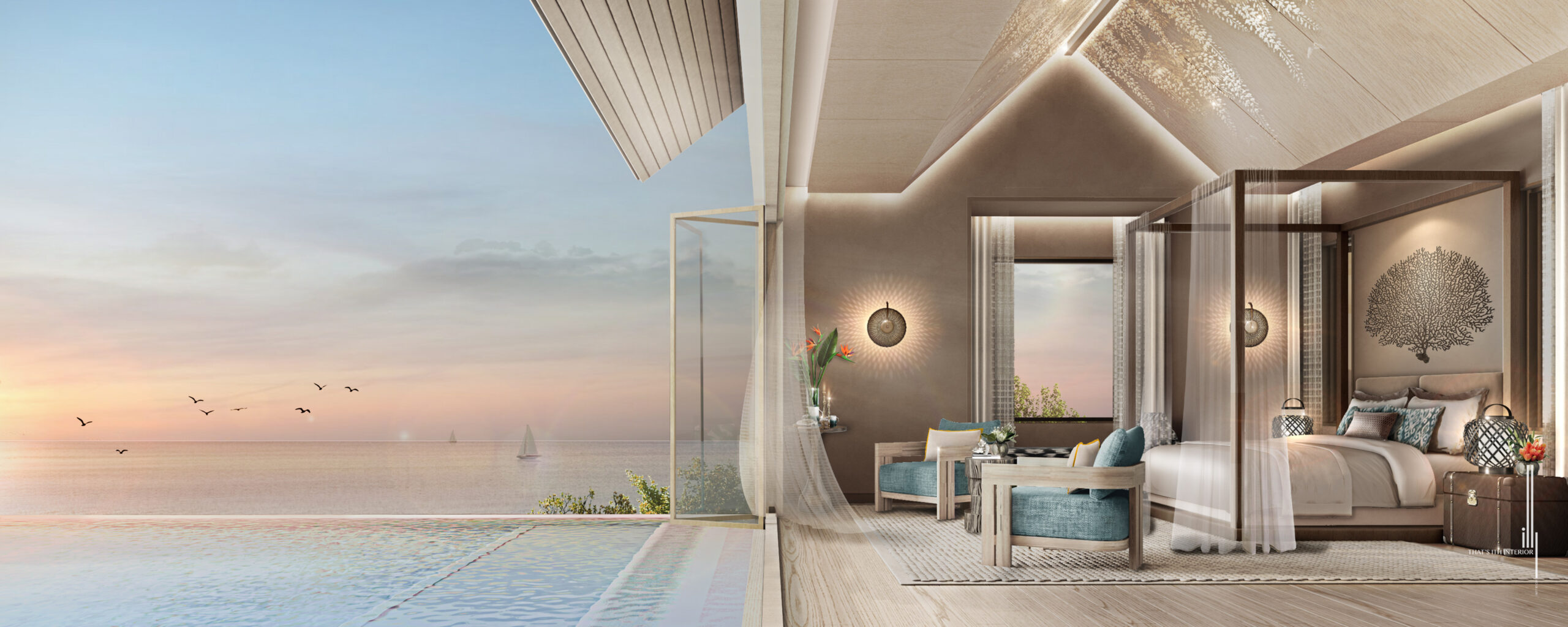
Resorts can also involve dispersed buildings, extensive landscape, indoor-outdoor spaces, standalone villas, long guest routes, pools, terraces, and greater exposure to climate.
A coastal resort in Thailand may need to respond to humidity, intense sunlight, heavy rain, salt air, natural ventilation, shade, and the way materials weather over time.
These are not conditions to resolve after the concept is finished.
They are part of the concept.
1. Discovery: Understand the Place Before Designing the Style
Strong resort design should begin before the mood board.
The first task is understanding what already exists.
The land.
Views.
Climate.
Architecture.
Landscape.
Culture.
Guest profile.
Brand.
Operator.
Commercial positioning.
And the expectations of the developer.
The important question is not immediately:
“What should this resort look like?”
It is:
“What experience belongs here?”
A beachfront site may suggest one response.
A forest, mountain, historic property, wellness destination, or island site may suggest something completely different.
Discovery gives the later design decisions a reason.
Without it, a resort may become beautiful but interchangeable.
2. Define the Identity Before the Details
Concept design translates discovery into a central design idea.
This is more than choosing an aesthetic.
A strong resort concept should help explain why the arrival feels a certain way, why particular materials belong, how the villa relates to the landscape, and why different restaurants or amenities feel connected without looking identical.
The concept becomes a decision-making tool.
When questions emerge later — and they will — the team can return to it and ask:
Does this decision strengthen the identity or weaken it?
At That’s ITH, this is fundamental because we do not believe every project should inherit the visual signature of the designer.
The resort itself should become the protagonist.
3. Design the Whole Guest Journey
Resort guests do not experience departments.
They experience one continuous place.
The road approaching the property.
Arrival.
Lobby.
Path to the villa.
Room reveal.
Breakfast.
Pool.
Spa.
Restaurant.
Nighttime return.
The interior designer, architect, landscape architect, and operator may each have different contractual responsibilities, but the guest sees none of those boundaries.
That makes coordination essential.
A powerful resort can use movement itself as part of the experience.
Landscape can conceal a building before revealing it.
A shaded path can create decompression.
A compressed threshold can make the view beyond feel larger.
A transition from active public areas toward a private villa can gradually reduce stimulation.
The spaces between destinations are part of the design, not leftover circulation.
4. Integrate Architecture, Interiors, and Landscape Early
Resort design becomes much harder when architecture, interior design, and landscape are developed as separate visual layers.
The relationship between them affects almost everything.
A lobby view depends on landscape.
Villa privacy may depend on planting and orientation.
A terrace depends on shade.
An outdoor bathroom depends on architecture, drainage, landscape screening, lighting, and interior materiality simultaneously.
A resort interior design company therefore needs to collaborate closely with the project’s architects, landscape architects, engineers, operators, and specialist consultants.
The disciplines remain professionally distinct.
But experientially, the project needs to feel continuous.
The guest should experience one resort, not a collection of consultant packages.
5. Develop Materials for Climate, Use, and Age
Resort materials need to do more than look convincing in samples.
They need to survive the environment.
Humidity.
UV exposure.
Rain.
Salt air in coastal locations.
Cleaning.
Luggage.
Food and beverage use.
Wet swimwear.
High guest turnover.
Natural materials such as stone, timber, woven surfaces, plaster, and metal can create enormous richness, but their suitability depends on location, treatment, detailing, maintenance, and exposure.
Sometimes weathering itself can become part of the design.
Sometimes it needs to be prevented aggressively.
The important point is that material performance and aesthetic intention should be considered together.
A resort material should not only look good on opening day. The designer should think about what it will become afterwards.
6. Design Villas as Experiences, Not Larger Guestrooms
Villas often represent the highest-value accommodation within a resort.
They deserve more than simply enlarging a standard guestroom plan.
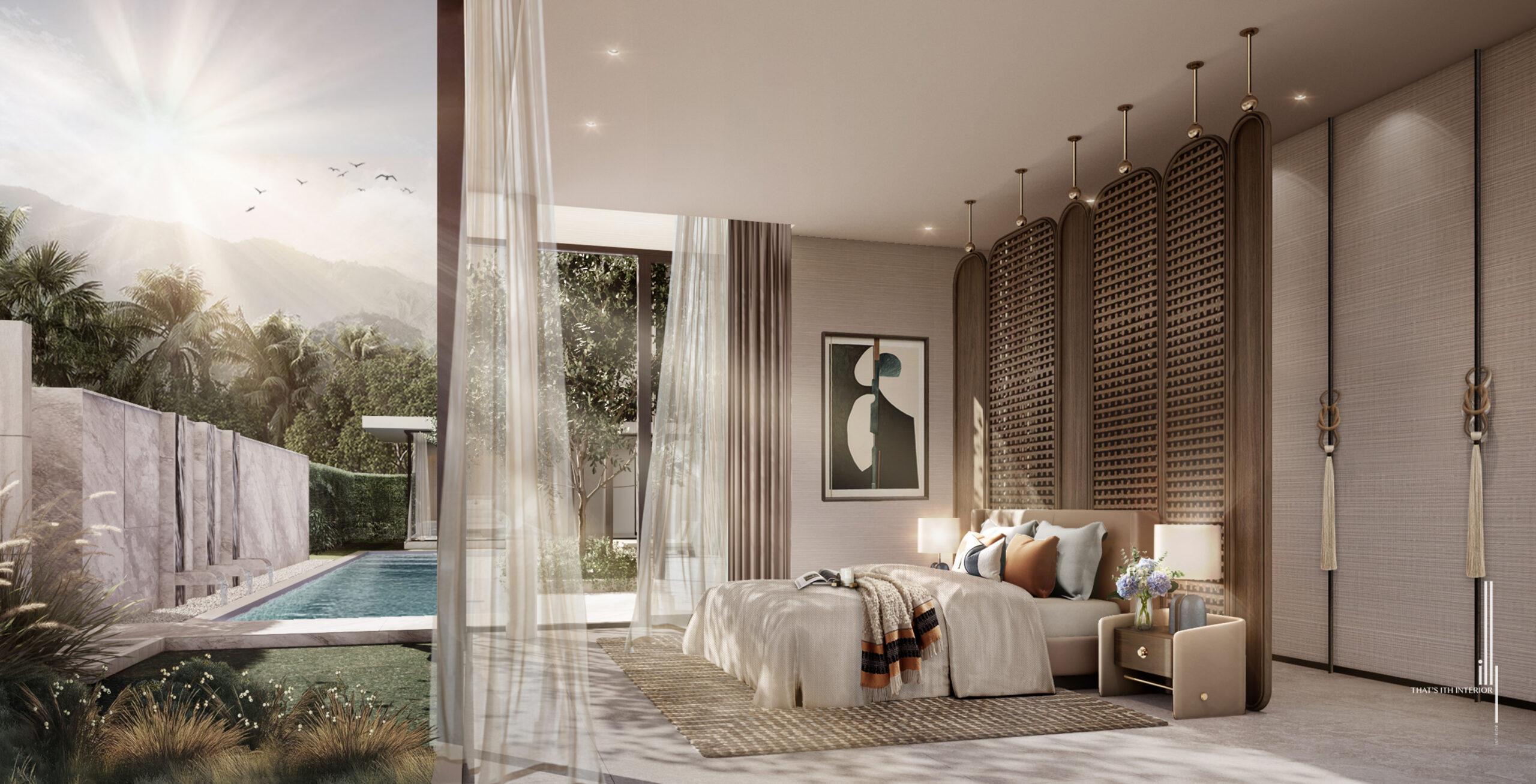
Villa guests may stay longer and expect more privacy, storage, residential comfort, indoor-outdoor living, private pools, terraces, gardens, or separate living and dining areas.
The design therefore has to work at another rhythm.
Arrival can become more private.
Outdoor space can become an extension of the room.
Landscape becomes part of the interior experience.
Furniture needs to support longer periods of use.
Projects such as The Title Villa Kirara Phuket and ANANN Villas Phuket illustrate the importance of treating villa living as a relationship between interior, landscape, privacy, and climate rather than simply a larger enclosed room.
7. Develop FF&E and Bespoke Elements With Reality in Mind
FF&E — furniture, fixtures, and equipment — often carries much of the tactile identity of a resort.
Depending on the scope, a resort interior design company may specify or develop furniture, decorative lighting, rugs, artwork, accessories, outdoor furniture, and bespoke pieces.
But resort FF&E has particular demands.
Outdoor furniture needs to respond to weather.
Upholstery needs to consider maintenance.
Custom pieces need realistic manufacturing timelines.
Replacement strategy matters.
And bespoke design should have a reason.
A custom piece becomes valuable when it expresses something specific about the resort, solves an unusual condition, or creates a moment guests remember.
Customising everything simply because the property is luxurious can create unnecessary cost and operational complexity.
Specificity creates value when it has purpose.
8. Turn the Vision Into Buildable Information
A resort cannot be constructed from renderings.
After concept design comes a less visible but critical stage: translating the idea into increasingly precise information.
Depending on the consultant’s contractual scope, this may include plans, elevations, sections, joinery details, finish schedules, FF&E information, and other interior documentation required for coordination, pricing, fabrication, or construction.
This is where technical depth becomes visible.
Design development answers the question:
Exactly how will this idea become physical?
Dimensions need to work.
Material junctions need resolving.
Lighting needs coordinating.
Furniture needs fitting.
Architecture, engineering, and interior details need to coexist.
Renderings communicate the aspiration.
Detailed design gives other teams the information needed to realise it.
9. Protect the Concept Through Value Engineering
Almost every real resort project encounters budget pressure.
This is not automatically a threat to design.
Poor value engineering is.
Replacing every expensive element with a cheaper visual approximation can gradually remove the identity of a project while technically preserving the drawing.
A stronger resort interior design company should understand hierarchy.
Which elements carry the concept?
Where will guests feel the investment?
What can be simplified?
What can be sourced differently?
What can disappear entirely without weakening the experience?
Sometimes reducing cost means changing a material.
Sometimes it means redesigning the detail.
Sometimes the smartest solution is simply doing less.
Good value engineering removes cost before it removes the idea.
10. Manage Procurement and Lead-Time Reality Early
Custom furniture, stone, lighting, textiles, specialist finishes, samples, prototypes, and imported components can all affect programme.
Procurement responsibilities vary by appointment; some design firms provide design and specification only, while others may offer procurement support or more extensive purchasing services.
Regardless of contractual responsibility, design decisions need to acknowledge lead times early.
A beautiful item that cannot arrive before opening is not a useful specification.
The same applies to something that cannot realistically be repaired, replaced, or reproduced later.
This is where design meets project planning.
11. Protect Design Intent During Construction
Construction is where hundreds of small decisions begin to accumulate.
Site dimensions differ.
Services conflict.
Materials become unavailable.
A contractor proposes an alternative.
A detail proves difficult to fabricate.
None of these situations necessarily damages the project.
The danger comes when each is resolved independently without understanding the larger idea.
Where construction-stage services form part of the appointment, the interior design team may review relevant shop drawings or samples, respond to design-related questions, attend agreed site reviews, and assess elements against the approved design intent.
This is not necessarily the same as statutory supervision, construction management, or responsibility for construction methods.
Exact responsibilities depend on the contract.
But the design principle is important:
Protecting the vision does not mean preventing change. It means understanding what the project cannot afford to lose when change becomes necessary.
Common Ways a Resort Loses Its Identity
Even well-funded projects can drift.
Designing before understanding the site
Starting with an aesthetic can produce a resort that feels imported rather than rooted.
Treating landscape as background
Interior, architecture, and landscape need to participate in the same guest journey.
Prioritising photographs over comfort
A spectacular outdoor setting without adequate shade, airflow, privacy, or comfortable furniture quickly reveals its weakness.
Ignoring material ageing
What looks convincing in a mock-up may perform very differently after years of tropical exposure.
Treating villas like enlarged hotel rooms
Premium accommodations need a more residential understanding of privacy, dwell time, and indoor-outdoor use.
Allowing value engineering to become concept erosion
Small substitutions can eventually remove everything that made the original design distinctive.
How to Choose a Resort Interior Design Company
Developers should look beyond attractive resort imagery.
Ask whether the studio demonstrates:
- Site-specific thinking — do different projects genuinely respond to different places?
- Relevant climate experience — particularly for tropical, island, or beachfront projects
- Strong built work — not only renderings
- Indoor-outdoor design intelligence
- Experience collaborating with architecture and landscape teams
- Understanding of villa planning and privacy
- Material and FF&E knowledge
- Technical capability appropriate to the appointed scope
- Operational awareness
- A clear process for protecting design intent through change
Perhaps the most important question is:
Can this team explain what is essential to the identity of our resort — and what can change without losing it?
Why Local Knowledge Matters for Resort Interior Design in Thailand
Thailand offers a sophisticated ecosystem of hospitality contractors, fabricators, furniture manufacturers, materials, craftspeople, and specialist suppliers.
For an international developer, a Thailand-based resort interior design company can help connect international project expectations with those local capabilities.
The advantage is not simply lower cost or easier sourcing.
It is knowing what can be made well.
Which materials suit the climate.
Which craft traditions can be reinterpreted.
How local suppliers work.
And where regional knowledge can improve the design rather than simply execute it.
Local expertise should not make every resort look Thai.
Its value is making the design more intelligent about where it is being built.
That’s ITH’s Approach to Resort Interior Design
At That’s ITH Interior, we believe the role of a resort design company is not simply to create the vision.
It is to protect the identity of that vision while allowing it to survive reality.
We begin with the site.
Its climate.
Landscape.
Culture.
Audience.
Brand.
Operations.
And the emotional experience that should exist between all of them.
From there, the design may become bold or restrained, highly crafted or deliberately quiet.
The answer changes because the place changes.
For us, Fearless Luxury is not a resort aesthetic.
It is the confidence to make the decision the project genuinely needs — and the discipline to know which decisions matter most when budgets, technical requirements, and construction begin to test the original idea.
We do not believe every resort should look recognisably “That’s ITH.”
We believe every resort should become unmistakably itself.
That is what Designing Places People Remember means from vision to reality.
Explore That’s ITH resort and hospitality interior design projects.
Planning a Resort Development?
The most valuable time to involve a resort interior design company is before architecture, landscape, guest journey, and operational decisions have become difficult to influence.
Led by founder and designer ITH Palach, That’s ITH Interior is a Bangkok-based interior design studio working across hospitality, residential, and commercial projects in Thailand and international markets.
We collaborate with developers, resort operators, architects, landscape architects, and multidisciplinary consultant teams to translate site, identity, operations, and ambition into memorable built environments.
Contact That’s ITH Interior to discuss your next resort, villa, hotel, or hospitality development.
Frequently Asked Questions
What does a resort interior design company do?
A resort interior design company develops and coordinates the interior experience of a resort.
Depending on its appointed scope, this may include research, concept design, guest journey, space planning, villas and guestrooms, materials, FF&E, design development, construction documentation, consultant coordination, and construction-stage design support.
How is a resort interior design company different from a hotel interior design company?
The core interior design skills overlap significantly.
Resort projects often place greater emphasis on landscape, climate, indoor-outdoor living, villas, privacy, semi-outdoor spaces, dispersed buildings, and guests spending longer periods within the property.
When should a resort interior design company join the project?
Ideally during early planning or concept development.
Early involvement allows interior design, architecture, landscape, guest journey, operational requirements, and climate response to develop together before major spatial decisions become difficult or expensive to change.
Why is climate experience important in tropical resort design?
Humidity, rain, UV exposure, heat, and salt air in coastal locations can significantly affect materials, furniture, finishes, hardware, maintenance, and semi-outdoor spaces.
Design teams need to consider these conditions during specification and detailing rather than after construction begins.
Does a resort interior design company handle FF&E procurement?
It depends on the appointment.
Some companies provide FF&E design and specification only, while others may also offer procurement support, purchasing, logistics, installation, or related services. Responsibilities should be clarified contractually at the beginning of the project.
How does value engineering affect resort interior design?
Value engineering can reduce cost without necessarily weakening the design when the team understands which elements are fundamental to the concept.
The objective should be to simplify, substitute, or redistribute investment intelligently while protecting the decisions that create identity and guest experience.
Why is landscape coordination important in resort design?
Landscape influences arrival, views, privacy, shade, circulation, outdoor living, and the relationship between buildings.
Although interior design and landscape architecture remain separate professional disciplines, guests experience them as one continuous resort environment.
What should developers look for in a resort interior design company in Thailand?
Look for relevant built resort experience, strong site-specific thinking, understanding of tropical climate, indoor-outdoor design, villa planning, material durability, collaboration with architecture and landscape teams, technical capability, and operational awareness.
Most importantly, look for a studio capable of carrying a clear identity from early concept into the realities of construction and use.