
WHAT IS HOSPITALITY INTERIOR DESIGN?
GUESTS RARELY REMEMBER THE SQUARE METRES OF A HOTEL LOBBY.
THEY REMEMBER HOW IT MADE THEM FEEL.
THE ANTICIPATION BEFORE ENTERING A RESTAURANT. THE QUIET OF A CORRIDOR AFTER A LONG FLIGHT. THE FIRST GLIMPSE OF A VIEW FROM A SUITE. THE BAR THEY PHOTOGRAPHED, RETURNED TO, AND TOLD SOMEONE ABOUT MONTHS LATER.
THAT IS WHERE HOSPITALITY INTERIOR DESIGN BEGINS.
Hospitality interior design is the design of hotels, resorts, restaurants, bars, and other guest-facing spaces. It shapes how people feel, move, interact, and remember an experience.
It combines:
- Spatial planning
- Guest experience
- Brand identity
- Materials and finishes
- Lighting
- Furniture and FF&E
- Craftsmanship
- Operational requirements
For developers, hotel owners, and operators, hospitality interior design is more than an aesthetic decision.
A successful hospitality interior must work operationally, express the brand clearly, and create an experience that guests remember.
WHAT DOES HOSPITALITY INTERIOR DESIGN INCLUDE?
Hospitality interior design begins long before furniture and finishes are selected.
A hospitality interior designer may work across:
- Concept and design direction
- Guest journey and experience
- Space planning and circulation
- Material and finish selection
- Lighting and atmosphere
- Custom furniture and bespoke design
- FF&E
- Artwork and styling
- Technical design and documentation
- Coordination with architects, consultants, contractors, and operators
The process starts with both emotional and practical questions.
How should a guest arrive?
What should they notice first?
Where should they slow down?
How can staff move efficiently without disrupting the guest experience?
The answers influence everything from the sightline of a hotel lobby to the position of a bar, the texture of a material, or the moment a view is revealed.
A successful hospitality interior is not a collection of attractive objects.
It is a carefully planned experience.
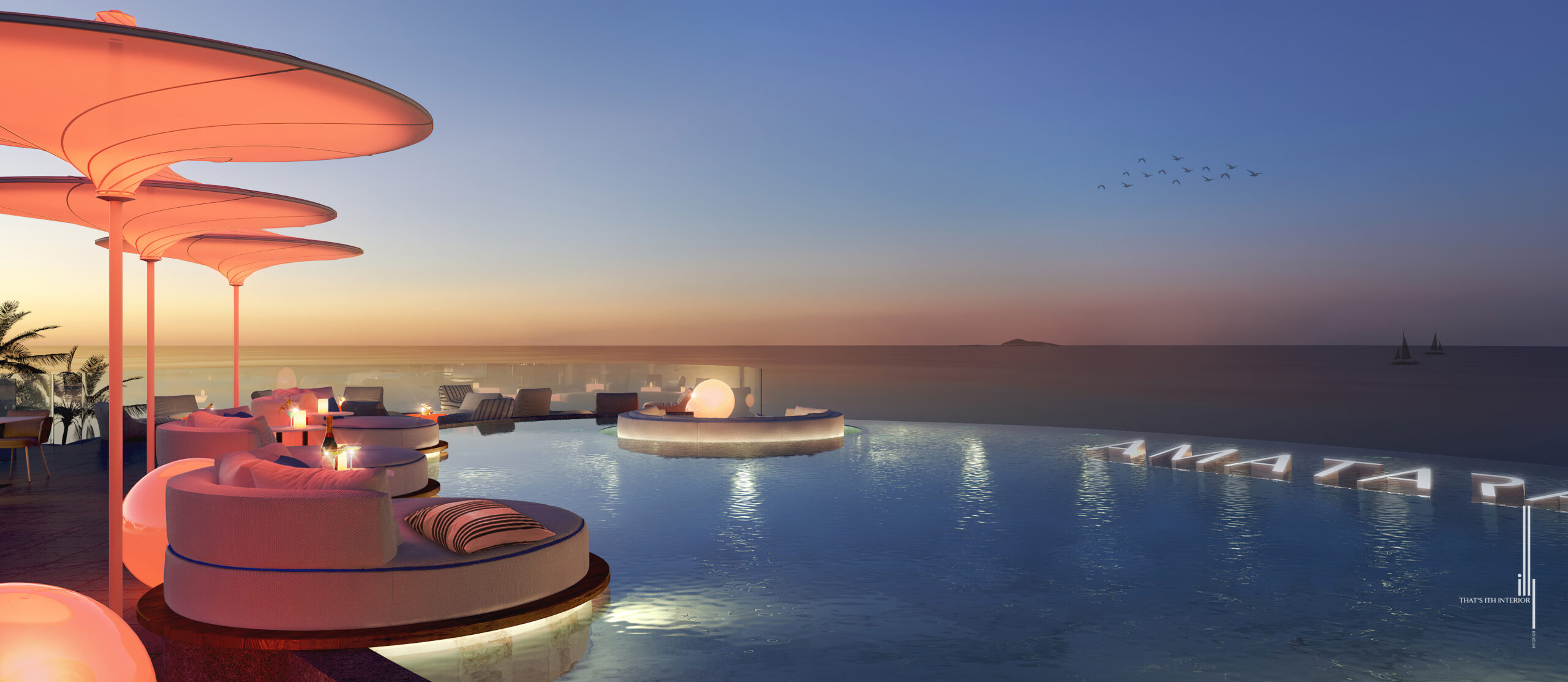
Amatara Hospitality Interior Design
HOW IS HOSPITALITY INTERIOR DESIGN DIFFERENT FROM RESIDENTIAL OR COMMERCIAL DESIGN?
The key difference is simple:
Hospitality design must create a personal experience for people the designer has never met.
Residential design is shaped around a particular person or family.
Workplace design responds to productivity, company culture, and business needs.
Hotels, resorts, and restaurants must welcome many different people while still making the experience feel personal and intentional.
This creates a unique design challenge.
Hospitality interiors must balance:
- Beauty and durability
- Guest comfort and operational efficiency
- Brand identity and flexibility
- Atmosphere and functionality
- Guest movement and staff movement
A restaurant must work during a busy service while still feeling atmospheric.
A hotel lobby may need to function as an arrival space, lounge, meeting point, and visual introduction to the brand.
At That’s ITH, we often think of hospitality design as choreography rather than decoration.
The designer is not only shaping rooms.
The designer is shaping how guests:
arrive → move → pause → discover → interact → remember
WHAT ARE THE CORE PRINCIPLES OF HOSPITALITY INTERIOR DESIGN?
1. START WITH IDENTITY, NOT STYLE
Every memorable hospitality project needs a reason to look and feel the way it does.
That reason may come from:
- The site
- Local culture
- History
- Architecture
- Landscape
- Brand personality
- A unique story
A strong concept becomes a design compass.
It guides decisions about space, materials, furniture, lighting, artwork, and details.
Without a clear idea behind the design, even an expensive interior can feel interchangeable.
With one, a space can feel as though it could exist nowhere else.
This is fundamental to That’s ITH.
We do not believe every project should look recognisable because the designer repeats the same visual style.
Each project should reveal its own identity.
2. DESIGN THE GUEST JOURNEY, NOT JUST THE ROOMS
Guests do not experience a hotel as a floor plan.
They experience a sequence:
Arrival → Anticipation → Transition → Discovery → Pause → Reveal
The route from the entrance to reception matters.
So does the moment between leaving a lift and entering a guestroom.
Good hospitality interior design maps these moments intentionally.
Sometimes the most powerful part of an experience is what happens just before the destination.
This is why hotel interior design should not be judged room by room.
The spaces between the major spaces can be just as important.
3. DESIGN WITH MORE THAN THE EYES
Hospitality interiors are multi-sensory.
Guests experience a space through:
- Light
- Acoustics
- Texture
- Temperature
- Scent
- Scale
- Materials
These elements can influence how a space feels before a guest consciously understands why.
For example, lighting can allow the same restaurant to feel energetic during breakfast and intimate after dark.
Softer surfaces can also change the acoustic character of a room.
The goal is to control atmosphere with enough precision that the experience still feels natural.
Good hospitality design is often felt before it is consciously noticed.
4. USE MATERIALS AND CRAFT TO CREATE SPECIFICITY
In luxury hospitality interior design, genuine luxury often comes from specificity rather than recognition.
This could mean:
- A local material used in an unexpected way
- Furniture created specifically for one space
- Regional craftsmanship reinterpreted through a contemporary design language
- Bespoke details that cannot easily be copied
Bespoke design matters because it gives a property something commercially valuable:
An identity that is difficult to copy.
The most memorable details are often those that could not simply be moved to another hotel and mean the same thing.
5. MAKE BEAUTY SURVIVE REALITY
Hospitality design must continue to work after opening day.
Furniture, fixtures, and equipment — commonly called FF&E — must support several requirements at once.
They need to consider:
- Aesthetics
- Durability
- Maintenance
- Housekeeping
- Safety
- Guest comfort
- Daily operations
A beautiful chair that cannot survive repeated use is not successful hospitality design.
Neither is a dramatic service counter that creates problems for the team working behind it.
This is where design meets operations.
A strong hospitality interior must remain convincing after thousands of guests, cleaning cycles, service routines, and years of daily use.
6. CREATE A SENSE OF PLACE WITHOUT USING CLICHÉS
The most compelling hotel and resort interiors feel connected to where they are.
But local identity should not be reduced to decorative symbols.
Designers can reinterpret:
- Vernacular architecture
- Regional craftsmanship
- Colour
- Food culture
- Landscape
- Local rituals
- Everyday objects
The goal is not simply to make a property look “local.”
The goal is to make it belong.
This is especially important in hospitality interior design in Thailand and Southeast Asia.
The region offers rich cultural identities, craft traditions, materials, and stories that can be translated into contemporary hospitality environments.
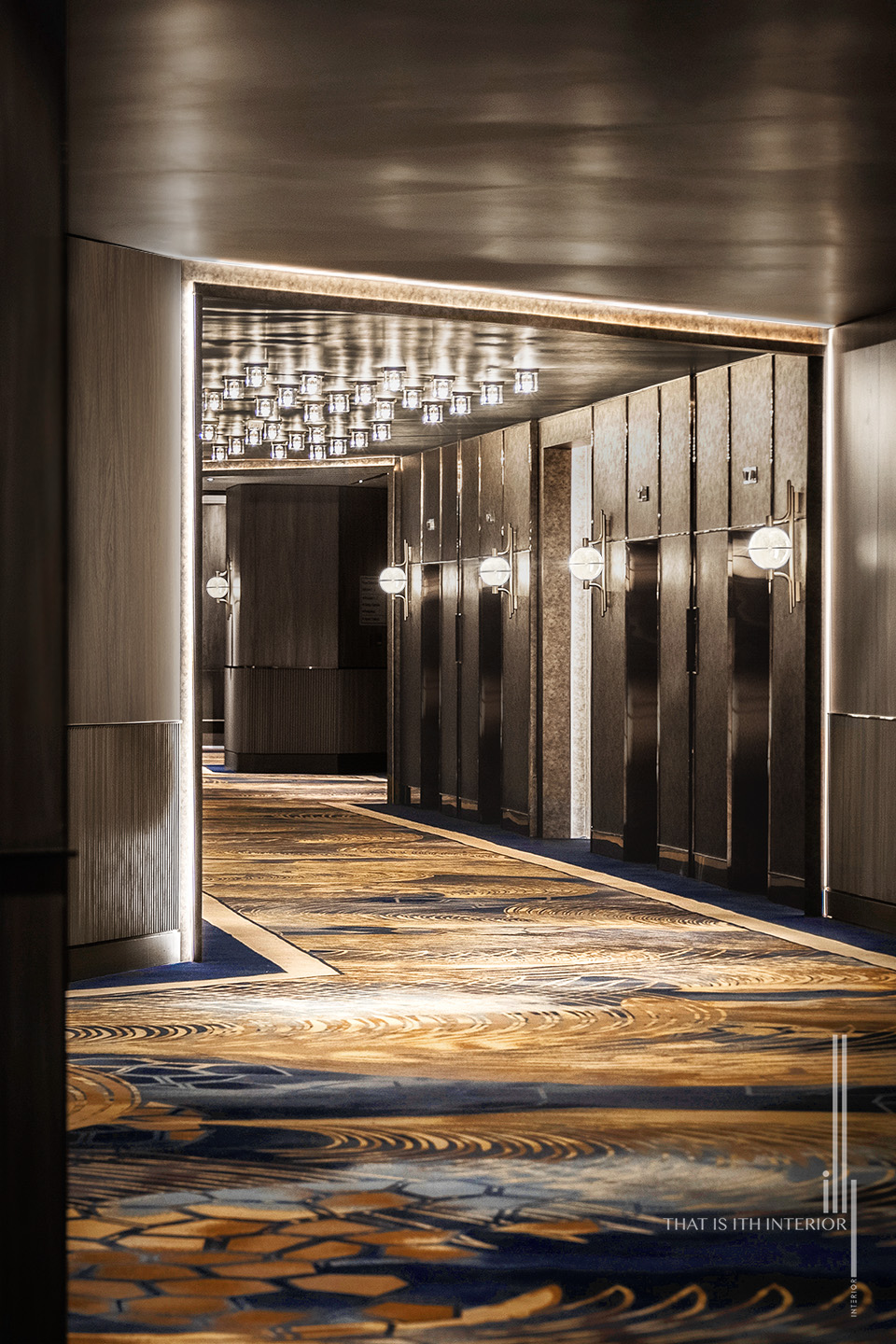
Sheraton Hospitality Interior Design
BOUTIQUE HOSPITALITY DESIGN VS. LARGE-SCALE HOTEL DESIGN
Boutique hotels and large hospitality properties do not necessarily differ in ambition.
They differ in constraints.
A boutique hotel or intimate resort may allow a more individual story to unfold at a smaller scale.
Large branded properties require another level of design coordination.
They may include:
- Repeated room types
- Multiple restaurants and outlets
- Event spaces
- Brand standards
- Operator requirements
- Guest circulation
- Back-of-house functions
- Service routes
- Maintenance requirements
All of these elements must work together while the property still maintains a clear identity.
For example, the design challenge of the Royal Orchid Sheraton Ballroom is fundamentally different from the social, lifestyle-driven character of LYF Sukhumvit 8, or the restaurant experience of Silver Waves at Chatrium Riverside Bangkok.
The visual languages are different.
But the central question remains:
How can a project create a distinctive identity without compromising the way it needs to perform?
A strong hospitality design studio should be able to answer that question across different scales, brands, and project types.
WHAT DOES A HOSPITALITY INTERIOR DESIGN CONSULTANT DO?
A hospitality interior design consultant helps translate a property’s brand, business needs, and guest experience into a buildable interior environment.
Depending on the project scope, the work may include:
Concept Design
Defining the design idea, narrative, atmosphere, and overall direction.
Space Planning and Guest Journey
Organising zoning, circulation, sightlines, transitions, and key guest moments.
Material and Finish Development
Selecting materials that support the concept while meeting performance and budget requirements.
FF&E and Bespoke Design
Developing or specifying furniture, lighting, artwork, accessories, and custom elements.
Design Development and Documentation
Translating the design concept into technical information for execution.
Coordination
Working with developers, architects, operators, engineers, consultants, suppliers, and contractors.
For international developers working in Thailand or Southeast Asia, a Bangkok-based hospitality interior design studio can also provide regional knowledge of:
- Craftsmanship
- Materials
- Local suppliers
- Supply networks
- Construction practices
The earlier these disciplines are considered together, the less likely the design is to become a series of compromises later.
Hospitality Interior Design Trends
HOW DO YOU CHOOSE THE RIGHT HOSPITALITY INTERIOR DESIGNER?
The right hospitality interior designer should demonstrate more than an attractive portfolio.
Look for clear design intelligence rather than a repeatable visual formula.
A strong studio should have a recognisable way of thinking without making every project look the same.
A varied portfolio can be a sign of strength.
A city hotel, resort, fine-dining restaurant, and social lifestyle property should not automatically share the same visual language because their contexts are different.
The designer should also understand both experience and execution.
Hospitality design needs to create emotion while responding to:
- Circulation
- Service
- Maintenance
- Durability
- Budget
- Brand standards
- Construction realities
Most importantly, look for the ability to create identity.
In a market filled with visually polished hotels and restaurants, beauty alone is increasingly easy to reproduce.
Identity is harder.
A useful question for any hospitality interior designer is:
Why should this hotel exist here?
Why should it feel this way?
What will make a guest remember it rather than the hundred other beautiful places they have seen?
THAT’S ITH’S APPROACH TO HOSPITALITY INTERIOR DESIGN
At That’s ITH Interior, we do not begin with a signature style.
We begin with identity.
That means understanding:
- The place
- The brand
- The culture
- The audience
- The story waiting to be revealed
The goal is not to make every hotel, restaurant, or resort look recognisably “That’s ITH.”
It is to make each project feel so specific to its circumstances that it could belong nowhere else.
For us, Fearless Luxury is not about excess.
It is the confidence to make distinctive choices with purpose.
Sometimes that means:
- An unexpected colour
- A dramatic spatial sequence
- Local craftsmanship interpreted in an unfamiliar way
- A bespoke object that becomes the emotional centre of a room
Sometimes it means restraint.
Across projects such as the Royal Orchid Sheraton, LYF Sukhumvit 8, and Silver Waves at Chatrium Riverside Bangkok, the visual language changes because the identity, audience, and experience change.
What remains consistent is the thinking:
Understand what makes a project distinctive. Translate that identity into space. Carry the idea from the guest journey down to the smallest detail.
That is what designing places people remember means to us.
A memorable hospitality interior should:
- Support the operator
- Strengthen the brand
- Belong to its location
- Create an emotional response
- Remain memorable long after the guest has left
PLANNING A HOTEL, RESORT, OR RESTAURANT PROJECT?
The most important hospitality design conversations should begin long before finishes are selected.
Led by founder and designer ITH PALACH PAINUPONG (อิฐ พลัช ภายนุปอง), whose design career spans more than 25 years, That’s ITH Interior is a Bangkok-based interior design studio working across hospitality, residential, and commercial projects in Thailand and international markets.
We work with developers, brands, and hospitality operators to translate identity, location, and ambition into spaces with lasting emotional resonance.
CONTACT THAT’S ITH INTERIOR to discuss your next hotel, resort, restaurant, bar, or hospitality development.
FREQUENTLY ASKED QUESTIONS
WHAT IS HOSPITALITY INTERIOR DESIGN?
Hospitality interior design is the design of hotels, resorts, restaurants, bars, and other guest-facing spaces.
It combines spatial planning, guest experience, brand identity, materials, lighting, furniture, FF&E, and operational requirements to create spaces that function effectively and leave a memorable impression.
WHAT IS THE DIFFERENCE BETWEEN HOSPITALITY INTERIOR DESIGN AND INTERIOR DECORATION?
Interior decoration focuses mainly on furnishings, finishes, accessories, and styling.
Hospitality interior design is broader.
It can begin at the concept stage and include:
- Space planning
- Guest journey
- Lighting
- Materials
- Bespoke furniture
- FF&E
- Operational requirements
- Technical documentation
WHY IS INTERIOR DESIGN IMPORTANT FOR HOTELS AND RESORTS?
Interior design shapes how guests navigate, perceive, use, and remember a property.
Strong hospitality design can:
- Reinforce brand identity
- Support hotel operations
- Improve the guest experience
- Differentiate the property
- Influence how guests perceive its overall value
WHEN SHOULD AN INTERIOR DESIGNER JOIN A HOTEL PROJECT?
Ideally, a hospitality interior designer should become involved during the early planning or concept stage.
Early involvement allows architecture, guest circulation, operator requirements, brand positioning, and interior experience to develop together.
It can also reduce costly changes later in the project.
WHAT SHOULD I LOOK FOR IN A HOSPITALITY INTERIOR DESIGNER IN THAILAND?
Look for a studio with:
- A clear design philosophy
- A relevant and varied portfolio
- Hospitality experience
- An understanding of hotel operations
- Technical execution experience
- Strong coordination skills
- The ability to respond to the project’s brand, location, audience, and commercial requirements
The best studio is not necessarily the one with the most recognisable style.
Look for the studio that can create the right identity for your project.
CAN THAT’S ITH WORK WITH INTERNATIONAL HOTEL OPERATORS AND OVERSEAS DEVELOPERS?
Yes.
That’s ITH Interior is based in Bangkok and works with multidisciplinary teams across projects in Thailand and international markets.
The studio combines local and regional understanding with a process suited to developers, operators, consultants, and project teams working across different markets.