
7 Luxury Villa Interior Design Ideas That Make a Villa Feel Truly Personal
A villa offers something few other residential types can.
Space.
Privacy.
Landscape.
A closer relationship between inside and outside.
And enough freedom for the architecture, interiors, pool, garden, and daily life of the household to become one continuous experience.
But that freedom creates its own risk.
A large villa can easily become a collection of impressive rooms with very little relationship to one another.
The real challenge of luxury villa interior design is not filling more space. It is giving all that space a reason to belong together.
The strongest villas are therefore not necessarily the largest, most expensive, or most visually dramatic.
They are the ones that understand the people living there, the climate around them, the landscape outside them, and the difference between a house that photographs beautifully and one that continues to feel right after years of actual life.
These seven principles can help turn a luxury villa into something more specific than an image of luxury.
1. Design Around the Household Before Designing the Villa
The most important luxury villa interior design idea may also be the least visual:
understand who actually lives there.
A villa for a family with young children should not behave like a villa designed primarily for entertaining.
A weekend retreat for two should not automatically follow the same planning logic as a multi-generational family home.
A residence occupied year-round may need very different storage, service circulation, kitchens, workspaces, and maintenance considerations from a villa used only seasonally.
Before discussing style, the designer should understand:
- who lives in the villa
- how often guests stay
- how frequently the household entertains
- whether family members naturally gather or prefer separate territories
- how food is prepared and served
- whether domestic staff are part of daily life
- how much privacy different people need
- whether the villa is a primary residence, holiday home, or both
- how those needs may change over time
These questions shape the plan far more profoundly than a palette or mood board.
A family may ask for an “open-plan villa” while also wanting absolute privacy when guests arrive.
Another may want a dramatic formal living room but spend nearly every evening together in a smaller family space.
Those contradictions are useful.
A villa should not be designed around an imaginary lifestyle simply because that lifestyle photographs well. It should be designed around the one that will actually happen there.
2. Make Indoor and Outdoor Living Feel Like One Experience
For luxury villas in Thailand, the relationship between interior and exterior can become one of the property’s greatest assets.
But indoor-outdoor living requires more than installing large sliding doors.
The transition needs to feel deliberate.
Floor levels.
Thresholds.
Shade.
Furniture.
Lighting.
Materials.
Views.
Drainage.
Air movement.
Landscape.
All influence whether indoor and outdoor spaces genuinely work together.
A living room that opens toward a pool may feel visually connected to it but still fail if the terrace becomes too hot to use for most of the day.
An outdoor dining area may look beautiful while becoming uncomfortable in heavy rain.
A pool deck may continue the same stone visually, but the material may need entirely different slip resistance and performance outdoors.
Good indoor-outdoor design is not the elimination of boundaries. It is the intelligent design of the boundary itself.
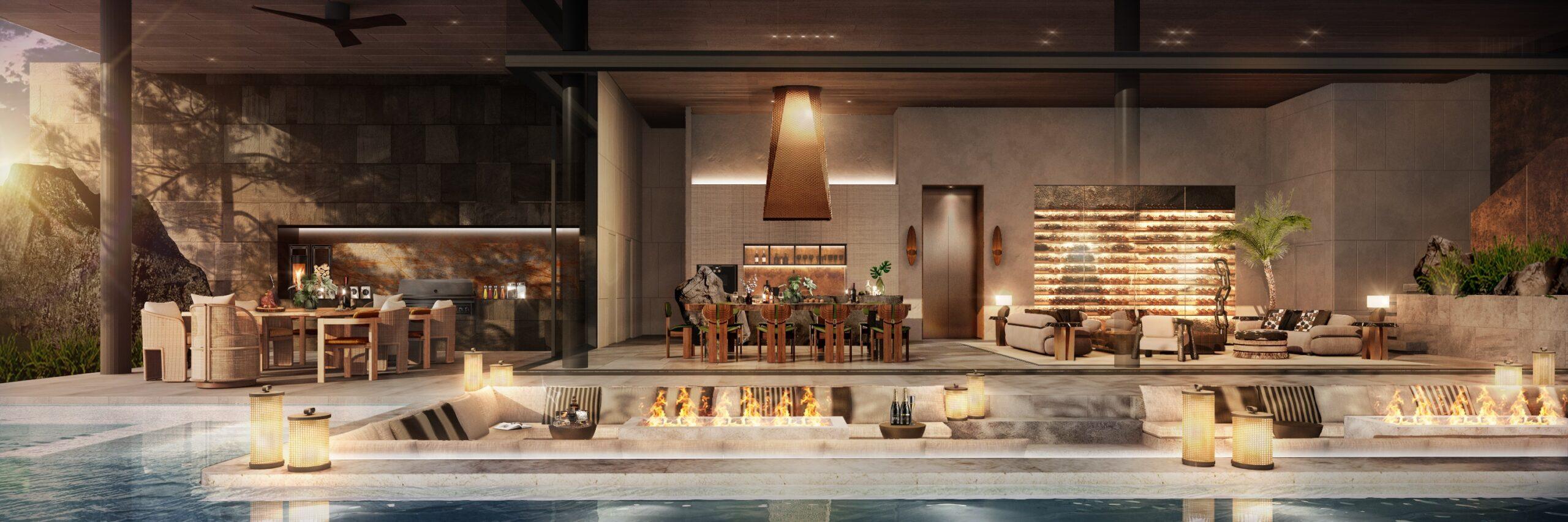
Projects such as ANANN Villas Phuket and The Title Villa Kirara Phuket demonstrate how villa living can extend beyond enclosed rooms into terraces, pools, landscape, and views.
Let the Pool Become Part of the Architecture
In a private pool villa, the pool should not feel like an amenity placed outside after the house has been designed.
It can influence the entire spatial experience.
Water can become part of the arrival.
A reflection visible from inside.
A visual extension of the living area.
A buffer creating privacy.
Or the social heart of the property.
Sightlines toward water can begin long before a guest reaches the pool itself.
Materials may continue between living spaces and terraces.
Lighting can transform the water after dark.
Bedrooms can be positioned around different levels of relationship to the pool.
The most successful private pool villa design makes the water feel like part of the spatial composition rather than a blue rectangle in the garden.
3. Design Privacy as Carefully as Openness
Luxury villas often celebrate openness.
Large glazing.
Expansive terraces.
Long views.
Open-plan living.
Outdoor bathrooms.
Pools visible from major rooms.
But openness only feels luxurious when people still feel protected.
The more visually open a villa becomes, the more deliberately privacy has to be designed.
Privacy does not always require solid walls.
It can come from:
- landscape screening
- changes in level
- building orientation
- offset openings
- courtyards
- screens
- planting
- indirect circulation
- furniture orientation
- acoustic separation
A pool can feel open to the landscape while remaining protected from neighbouring properties.
A bedroom can have a large view without making its occupant feel exposed.
A guest can enter a villa without immediately seeing deeply into family areas.
This balance becomes particularly important in large private homes where entertaining and family life happen simultaneously.
Create Different Degrees of Privacy
Privacy is rarely binary.
A well-designed villa can contain several levels of retreat.
A formal living room may be highly social.
A family lounge more protected.
A terrace may be shared by everyone.
A reading corner may belong almost entirely to one person.
Bedrooms may have their own outdoor spaces.
Even within a couple’s suite, one person may need somewhere to work or read without disturbing the other.
The objective is not to isolate everybody.
It is to give people choice.
Luxury is partly the ability to decide when to participate and when to withdraw.
4. Let Climate Shape the Design Instead of Fighting It
In tropical luxury villa interior design, climate should not appear only in the technical section of the project.
It can become part of the design language itself.
Sun.
Rain.
Humidity.
Shade.
Air movement.
Heat.
These conditions influence how the villa is experienced every day.
Shade Can Be Luxury
A shaded veranda may be more valuable than another air-conditioned room.
Deep overhangs can create outdoor spaces usable through more of the day.
Screens can soften direct sunlight while contributing to privacy.
Covered walkways can transform circulation between buildings into an experience rather than an inconvenience.
A courtyard can bring daylight into the centre of the villa while controlling exposure.
Shade is not what remains after architecture blocks the sun. It can be architecture.
Natural Ventilation Should Be Designed, Not Romanticised
Opening a villa to natural air movement can create an extraordinary sense of connection with the climate.
But it also requires realistic consideration of humidity, insects, rain, acoustics, air-conditioning zones, and how the household actually uses the house.
Some spaces may work beautifully as naturally ventilated transitional areas.
Others may require more controlled environments.
The goal is not to prove that a tropical villa can operate without enclosure.
It is to decide intelligently where openness genuinely improves life.
5. Use Materials and Craft to Make the Villa Belong
Luxury villa interior design often includes beautiful natural materials.
Stone.
Timber.
Metal.
Textiles.
Plaster.
Woven surfaces.
But simply using natural materials does not automatically create authenticity.
The better question is:
Why does this material belong here?
Does it respond to the architecture?
The climate?
The site?
The client’s relationship with texture?
The way the surface will age?
Local making capability?
A villa becomes more convincing when materials feel connected to its circumstances rather than selected from a universal luxury palette.
Let Materials Age With the House
Private villas are lived in differently from show homes.
Floors are walked on.
Doors are touched.
Timber changes colour.
Metal develops character.
Stone acquires marks.
Outdoor surfaces respond to rain and sunlight.
Trying to make every material look permanently untouched may create unnecessary maintenance and frustration.
In some projects, patina can become part of the beauty.
In others, the client may prefer surfaces that remain visually consistent.
Neither preference is automatically more sophisticated.
The designer needs to understand which kind of ageing the household will actually enjoy.
Luxury should consider not only how a material looks when it arrives, but what kind of relationship the owner will have with it ten years later.
Commission Something That Could Only Belong to This Villa
Bespoke design becomes particularly meaningful in a private villa because the brief can be extraordinarily specific.
A dining table shaped around how a family gathers.
A cabinet for a collection.
An artwork responding to the landscape.
A screen developed with a local craft technique.
A bench positioned for a particular morning ritual.
Custom joinery designed around an awkward architectural condition.
There is no reason for every piece to be bespoke.
In fact, trying to customise everything can create unnecessary expense and visual noise.
The stronger question is:
Which object deserves to exist only here?
One meaningful custom piece can create more identity than an entire room of recognisable luxury brands.
6. Design for Both Gathering and Retreat
Large villas often have a surprising problem.
They contain many rooms, but not necessarily the right rooms.
A formal living room nobody enters.
A huge dining room used three times a year.
An outdoor lounge too exposed to use in the afternoon.
Meanwhile, the family spends every night squeezed into one corner of the house because that is where everyone actually feels comfortable.
Luxury villa planning should therefore begin with behaviour rather than room labels.
Design Around How People Really Entertain
Some households host twenty people regularly.
Others invite two friends for dinner.
Some entertaining is formal.
Some happens around the kitchen.
Some moves immediately toward the pool.
Some families want guests to remain entirely within a public zone.
Others treat friends as part of family life.
The house should respond accordingly.
Guest circulation.
Powder rooms.
Kitchen relationships.
Bars.
Outdoor areas.
Service access.
Parking and arrival.
Acoustic separation.
All may change according to how the household actually gathers.
There is no universally luxurious way to entertain. There is only a way that is right for this household.
The Kitchen Should Reflect Culture and Behaviour
The luxury kitchen is another area where visual trends can quickly override reality.
Some households want cooking to be social and visible.
Others require a highly polished show kitchen supported by a separate working kitchen.
Some cook heavily every day.
Others barely use the kitchen themselves.
Certain cuisines create very different ventilation and preparation requirements.
A well-designed villa understands this before deciding how the kitchen should look.
The beautiful kitchen and the functional kitchen do not have to be enemies.
They simply need to begin with an honest brief.
Give Outdoor Spaces Different Personalities
A villa does not need one design mood repeated across the entire property.
The pool terrace might feel social and energetic.
A bedroom garden can feel protected.
An outdoor dining terrace may become more dramatic after sunset.
A courtyard can be contemplative.
A rooftop may exist almost entirely for evening use.
Creating different atmospheres gives a large property emotional variety.
A villa should feel like one coherent world, not one identical room repeated at different scales.
7. Design the Villa for Time, Not Just Opening Day
The best luxury villa interior design should work not only when the photographs are taken, but years later.
That requires thinking about three things:
change, maintenance, and ageing.
Leave Room for the Household to Change
Children grow.
Parents age.
Work patterns change.
Guests stay longer.
A room that once served as a playroom may eventually need another purpose.
Technology evolves.
Accessibility may become more important.
The goal is not to predict every future event.
It is to avoid designing the villa so rigidly that ordinary life changes immediately make major renovation necessary.
A room with the right proportions, infrastructure, storage, access, and lighting can often adapt without becoming generic.
Good flexibility is not designing a room for everything. It is designing a room with enough intelligence to become something else later.
Design Maintenance Before It Becomes a Problem
The more complex the villa, the more important maintenance becomes.
Outdoor fabrics.
Poolside furniture.
Timber.
Natural stone.
Metal.
Landscaped courtyards.
Specialist finishes.
Large glazing.
Lighting systems.
Automated doors.
All have consequences after the design team leaves.
A dramatic detail that requires constant specialist intervention can gradually become less luxurious rather than more.
The question should not be:
“Can this be built?”
It should also be:
“How will this be lived with?”
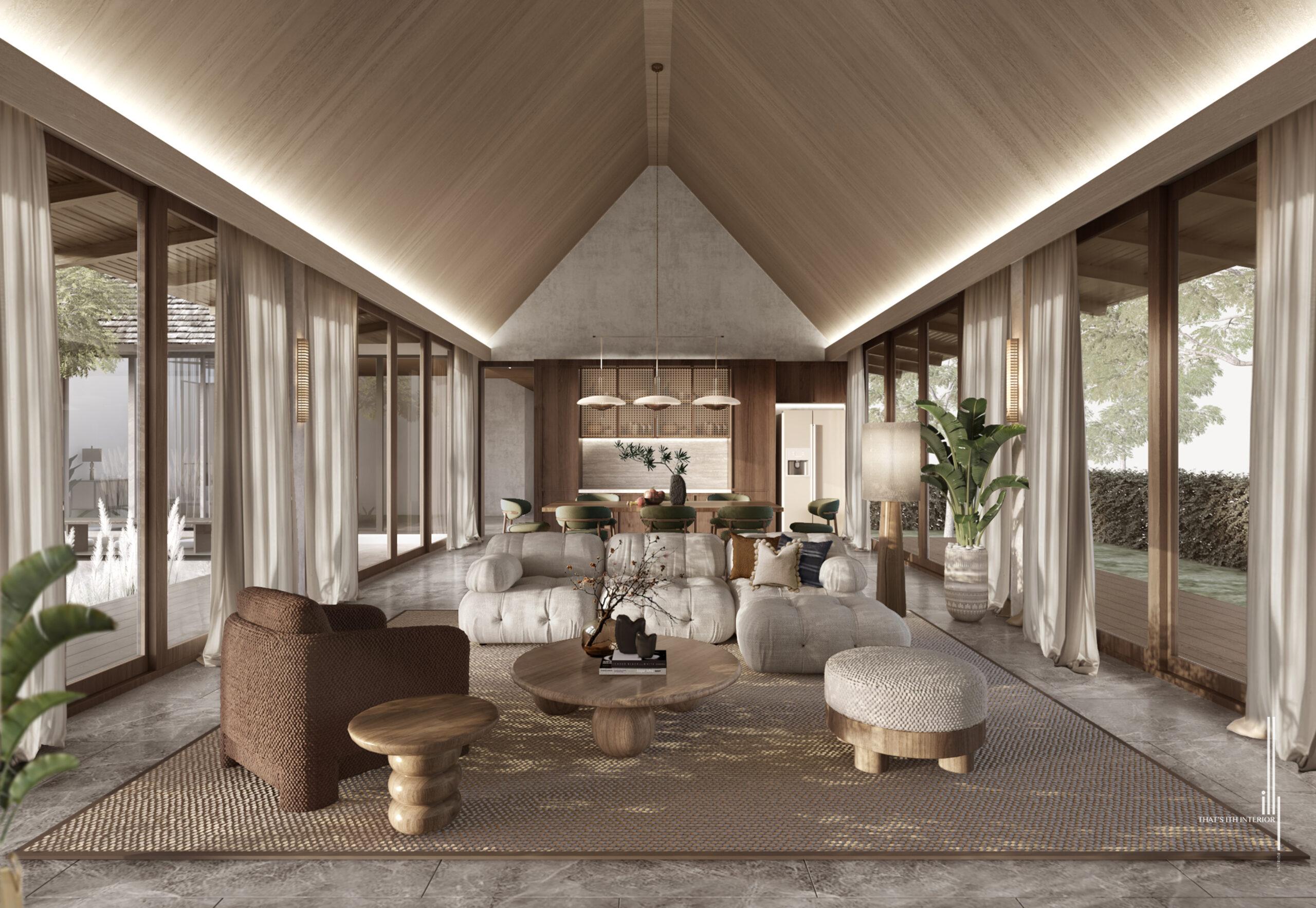
Projects such as Baan Suan – Nakhon Si Thammarat demonstrate how landscape, climate, and the everyday experience of a private property can become inseparable from the design itself.
What Makes Luxury Villa Interior Design Different From a Large House?
Size alone does not define a villa.
The more meaningful distinction is usually the relationship between private living, landscape, outdoor space, and a greater degree of spatial independence.
A villa may include:
- private garden
- swimming pool
- terraces
- separate pavilions or wings
- outdoor dining
- larger entertaining areas
- private guest accommodation
- stronger indoor-outdoor relationships
- more extensive service zones
- greater separation between household members
The designer therefore needs to think beyond individual rooms.
A villa is closer to a small private world.
The quality of that world depends on the relationships between all its parts.
Luxury Villa Interior Design in Thailand
Thailand offers particularly rich possibilities for villa design.
The tropical climate encourages a close relationship between interior, landscape, shade, terraces, courtyards, and water.
The country also has strong capabilities in furniture manufacturing, timber work, stone, textiles, metalwork, craft, and bespoke fabrication.
But designing well in Thailand does not mean automatically filling a villa with recognisable Thai motifs.
Local relevance can operate at a deeper level.
Climate response.
Material knowledge.
Construction intelligence.
Craft reinterpretation.
Landscape.
Lifestyle.
Ways of gathering.
Indoor-outdoor living.
The most interesting villa does not necessarily look “Thai.” It feels intelligent about being in Thailand.
A Framework for Evaluating Luxury Villa Interior Design Ideas
Before introducing any major design idea into a villa, ask:
- Does it reflect how this household actually lives?
- Does it strengthen the relationship between interior and site?
- Does it improve privacy, comfort, or daily use?
- Does it work with the climate rather than simply photograph well?
- Can the material or detail age and be maintained realistically?
- Does it add something specific to this villa?
- Will it still make sense when the family’s life changes?
If an idea cannot answer any of those questions, it may simply be decoration.
That’s ITH’s Approach to Luxury Villa Interior Design
At That’s ITH Interior, we do not begin a villa with an image of what a luxury villa is supposed to look like.
We begin with the people and the place.
Who lives here?
How do they gather?
Where do they retreat?
What relationship do they want with the landscape?
What kind of privacy do they need?
How should the house feel at different times of day?
And what can this particular site offer that another site cannot?
From there, architecture, interiors, landscape, materials, furniture, and light begin to find a common language.
That is why ANANN Villas Phuket, The Title Villa Kirara Phuket, Baan Suan – Nakhon Si Thammarat, and The Reserve Villas Sukhumvit 89/1 can speak different visual languages.
The site changes.
The household changes.
So the answer should change too.
For us, Fearless Luxury in villa design is not about making a house more dramatic or more visibly expensive.
It is the confidence to make choices specific enough to the people, climate, and place that the villa could not simply be moved somewhere else unchanged.
We do not aim for a recognisable villa style.
The consistency is in the judgment.
Explore That’s ITH luxury villa and residential projects.
Planning a Luxury Villa in Thailand?
The most valuable villa design conversations happen before the layout, architecture, and relationship with the landscape have already been fixed.
Led by founder and designer ITH Palach, That’s ITH Interior is a Bangkok-based interior design studio working across private residences, villas, hospitality, and commercial projects in Thailand and international markets.
We collaborate with homeowners, developers, architects, landscape architects, contractors, and multidisciplinary teams to translate lifestyle, site, climate, and identity into distinctive built environments.
Contact That’s ITH Interior to discuss your next private villa, pool villa, or residential project.
Frequently Asked Questions
What is luxury villa interior design?
Luxury villa interior design is the planning and development of a private villa’s interior around the lifestyle of its occupants, the architecture, landscape, climate, privacy requirements, materials, and relationship between indoor and outdoor living.
The objective is not simply to create expensive rooms, but a coherent private environment designed around a particular household and site.
How is luxury villa interior design different from apartment interior design?
A villa often involves a much stronger relationship between the interior and exterior environment.
Private landscape, pools, terraces, multiple entrances, larger social areas, guest accommodation, service zones, and greater privacy requirements can make villa planning more complex than an apartment contained within an existing building envelope.
How should a swimming pool relate to a luxury villa interior?
The pool can become part of the spatial composition rather than a separate amenity.
Sightlines, level changes, materials, lighting, landscape, privacy, and the relationship between indoor living and poolside spaces can all help integrate water into the overall experience of the villa.
Why is privacy important in luxury villa design?
Villas often use large openings and strong indoor-outdoor relationships, which can increase exposure.
Privacy can be designed through orientation, landscape, screens, level changes, courtyards, circulation, acoustic separation, and the positioning of different zones without sacrificing openness or views.
What materials work well for luxury villas in Thailand?
There is no single correct material palette.
Stone, timber, metal, plaster, glass, textiles, and woven materials can all work well when selected according to climate, exposure, maintenance, ageing, use, and the concept of the villa.
The important question is not simply whether a material looks luxurious, but whether it performs appropriately in its particular location.
Should every piece of furniture in a luxury villa be bespoke?
No.
Bespoke furniture is most valuable when it solves something specific: unusual dimensions, a family ritual, a collection, a functional requirement, or an important design moment.
Existing furniture can be equally appropriate when it suits the space.
How should a tropical villa respond to Thailand’s climate?
Tropical villa design should consider shade, rain, humidity, heat, UV exposure, ventilation, landscape, drainage, material performance, and the transition between conditioned and semi-outdoor spaces.
Climate should influence planning and material decisions from the beginning rather than being addressed only after the visual concept is complete.
How can a villa be designed to remain relevant as a family changes?
Designers can consider adaptable room proportions, future accessibility, storage, flexible furniture arrangements, technology infrastructure, and spaces capable of changing function over time.
The objective is not to predict the future exactly, but to avoid making the house unnecessarily rigid.
What should I look for in a luxury villa interior designer in Thailand?
Look for a designer with strong residential planning, built villa experience, understanding of tropical climate, indoor-outdoor design capability, material knowledge, bespoke furniture experience, and the ability to collaborate with architects and landscape designers.
Most importantly, look for someone who begins with your household and your site, rather than a predetermined image of what every luxury villa should look like.