
Hotel Interior Design Company: How to Choose the Right Partner
Developers may spend months evaluating a site, years securing investment, and considerable time selecting an operator.
Yet the hotel interior design company responsible for shaping how guests will experience the property for years to come can sometimes be chosen from a shortlist reviewed in a matter of days.
That decision deserves more weight.
Choosing a hotel interior design company is not simply about finding the portfolio you like most. It is about finding a design partner capable of turning brand, guest experience, operations, budget, and technical requirements into one coherent built environment.
A beautiful presentation is important.
But hotels are not presentations.
They are complicated, operational buildings that need to remain convincing after opening day, after thousands of guests, and after the original mood boards have long been forgotten.
For developers and hotel owners comparing design firms, this guide explains what to evaluate, what questions to ask, what warning signs to notice, and what separates a compelling designer from the right design partner for your project.
Why Choosing the Right Hotel Interior Design Company Matters
Hotel interior design decisions are interconnected.
An idea approved during concept design can affect space planning, architecture, lighting, material specification, FF&E, procurement, technical coordination, construction, and eventually operations.
The later a fundamental problem is discovered, the more difficult it can become to resolve.
That is why the role of a hotel interior design company extends far beyond producing attractive images.
A capable studio needs to protect the central idea while continually translating it through more detailed and practical stages of the project.
Depending on the appointment, that relationship may continue from early concept development through design development, construction documentation, and agreed construction-stage services.
You are not only selecting someone to imagine the hotel. You are selecting a team that can help carry the idea toward reality.
1. Look for a Way of Thinking, Not Just a Beautiful Portfolio
The first thing most developers review is the portfolio.
That makes sense.
But do not only ask:
“Do I like this?”
Ask:
“Why does each project look the way it does?”
Look across several projects.
Does every hotel, residence, restaurant, and resort share essentially the same palette and visual formula?
Or can you see that the studio has responded differently to different locations, brands, audiences, and briefs?
A strong design studio can have a recognisable way of thinking without forcing every project to share a recognisable aesthetic.
That distinction is important.
A boutique hotel in Bangkok, a beachfront resort in Phuket, and a large five-star urban property should not automatically look related simply because they were designed by the same company.
Their identities are different.
Their guests are different.
Their contexts are different.
The portfolio should demonstrate that the designer knows how to listen before deciding what the project should become.
2. Examine Built Work, Not Only Renderings
Concept images demonstrate imagination.
Built projects demonstrate what survives reality.
When evaluating a hotel interior design company, spend time looking at completed work in detail.
Consider:
- Does the material execution retain the strength of the original idea?
- Are transitions and secondary spaces resolved as carefully as hero areas?
- Does custom joinery look convincing when built?
- How are ceilings, lighting, furniture, and services coordinated?
- Do materials appear appropriate for their use?
- Does the project still possess identity beyond its most photographed angle?
A studio can produce extraordinary renderings and still struggle to translate them into construction.
That is why technical evidence matters.
Where confidentiality allows, developers can ask to review representative or redacted examples of interior drawings, elevations, joinery details, finish schedules, or FF&E documentation.
A rendering shows you what a studio can imagine.
A built project shows you what its process can deliver.
3. Understand How Far the Studio Carries the Design
Not every hotel interior design company provides the same scope of services.
Before comparing proposals, understand where each studio’s responsibility begins and ends.
Depending on the appointment, services may include:
- briefing and research
- concept design
- space planning
- schematic design
- design development
- material and finish specification
- FF&E design and specification
- bespoke furniture and joinery design
- interior construction documentation
- coordination with architects and consultants
- tender or procurement support
- construction-stage design services
- styling and installation support
Procurement, purchasing, site review, styling, visualisation, and specialist consultancy are not automatically included in every interior design appointment.
This is why comparing headline fees without comparing scope can be misleading.
Two proposals may appear to be offering the same service while actually ending at very different points in the project.
Ask for a clear scope and responsibility matrix.
What matters is not whether one studio includes everything. What matters is that everyone understands who is responsible for what.
4. Check Whether Their Experience Matches Your Project
Relevant experience matters, but this should be evaluated intelligently.
A studio does not necessarily need to have designed a hotel identical to yours.
In fact, hiring only designers who have repeated exactly the same typology can sometimes encourage exactly the kind of repetition a distinctive property is trying to avoid.
Instead, assess whether the team understands the complexity and conditions your project will introduce.
For a large five-star hotel, this might include:
- multiple guestrooms and room types
- several F&B outlets
- ballroom and function spaces
- operator or brand standards
- large consultant teams
- extensive documentation
- complex approval procedures
For boutique hotel interior design, the challenge may be different:
- smaller scale but greater individuality
- fewer spaces carrying more of the brand identity
- unconventional guestrooms
- owner-led decision making
- highly bespoke details
A good question is not simply:
“Have you done this exact project before?”
It is:
“Can you demonstrate that your team has the thinking, systems, and capacity required for this project?”
5. Understand Who Will Actually Work on Your Hotel
A compelling pitch may be presented by the studio founder or creative director.
But a hotel project can continue for months or years.
Developers therefore need to understand the team beyond the pitch meeting.
Ask:
- Who establishes the creative direction?
- Who leads the project day to day?
- Who attends design meetings?
- Who is responsible for technical coordination?
- Who develops FF&E?
- How is senior design oversight maintained?
- What happens if team members change during a long project?
- Who has authority to make design decisions?
There does not have to be one individual involved in every conversation from beginning to end.
Large projects need teams.
What matters is continuity of thinking and clarity of responsibility.
The best studios create systems that allow the original concept to remain understood even as different specialists contribute to it.
6. Ask How the Studio Works With Architects, Operators, and Consultants
Hotel design is collaborative by nature.
A hotel interior designer will usually need to coordinate with some combination of:
- architects
- hotel operators
- brand design teams
- structural and MEP engineers
- lighting consultants
- kitchen consultants
- landscape architects
- acoustic consultants
- signage and wayfinding consultants
- AV and technology specialists
- contractors
- suppliers and fabricators
This matters because excellent design ideas often meet their greatest challenges at the interfaces between disciplines.
A beautiful ceiling, for example, may need to accommodate lighting, air-conditioning, sprinklers, speakers, access panels, structure, and architectural geometry simultaneously.
Ask prospective studios how they coordinate.
Do they simply issue their information and wait for others to resolve conflicts?
Or do they actively engage in multidisciplinary design discussions?
Good collaboration does not weaken a design idea. It is usually what allows the idea to survive.
7. Ask the Right Questions Before Appointment
Once a shortlist has been created, ask every candidate a consistent set of questions.
Useful questions include:
- Can you show us built projects comparable in complexity to ours?
- Can you explain exactly what is included and excluded from your scope?
- Who will lead the project creatively and operationally?
- How do you maintain design continuity from concept through technical development?
- How do you coordinate with architects, operators, and specialist consultants?
- What level of interior construction documentation do you typically provide?
- How is FF&E design handled?
- Does your appointment include procurement or procurement support?
- How do you approach value engineering without losing the central concept?
- How do you handle design changes after major approvals?
- What information do you need from us to work effectively?
- Can you provide references from relevant previous clients, where appropriate?
The answers should reveal more than capability.
They should tell you what the relationship itself will feel like.
8. Look for How They Respond to Budget, Not Whether They Avoid It
A strong design company does not pretend budget does not exist.
Nor should budget automatically dictate every creative decision.
The important skill is knowing where investment matters most.
Some elements may deserve bespoke development because they define the project’s identity.
Others may be simplified with almost no impact on guest experience.
A skilled hospitality designer should be able to distinguish between the two.
Ask how the studio handles cost pressure and value engineering.
Do they simply replace expensive materials with cheaper ones?
Or can they protect the underlying design intention while changing the means of achieving it?
This is often where design intelligence becomes commercially valuable.
Good value engineering should remove cost before it removes the idea.
9. Compare Fees by Scope, Not by Headline Number
Hotel interior design fees can be structured in different ways depending on the studio, market, and project.
Common approaches may include:
- fixed or lump-sum fees for a defined scope
- phased fees linked to project stages
- area-based calculations
- percentage-based fees tied to an agreed cost basis
- time-based fees for certain services or additional work
There is no single fee model that is automatically better.
The important issue is transparency.
Developers should understand:
- what services are included
- what deliverables are expected
- how many design packages or areas are covered
- what constitutes additional scope
- whether travel is included
- how revisions are handled
- whether FF&E procurement is included
- what construction-stage services are included
- how additional work is charged
A cheaper proposal may genuinely be better value.
Or it may simply contain less scope.
Compare like with like before comparing price.
10. Be Suspicious of Unrealistic Timelines
Speed can be valuable.
Unrealistic speed creates risk.
A hotel interior design programme depends on project scale, decision-making speed, operator approvals, consultant coordination, number of spaces, technical complexity, and procurement requirements.
Some early design stages can move quickly.
Detailed development often cannot.
Bespoke furniture, custom lighting, specialist finishes, samples, prototypes, manufacturing, shipping, and installation can require significant lead time.
A credible studio should be willing to explain which decisions are on the critical path and when they need to be made.
This is more useful than promising that everything can happen “fast.”
A realistic programme is not a lack of ambition. It is part of professional design management.
Red Flags When Choosing a Hotel Interior Design Company
No single warning sign should necessarily disqualify a studio.
But several together deserve attention.
Potential red flags include:
- every project in the portfolio looks almost identical
- the team cannot clearly explain why design decisions were made
- only renderings are shown, with very little built evidence
- scope descriptions are vague
- nobody can explain who will actually lead the project after appointment
- technical coordination is treated as somebody else’s problem
- FF&E responsibilities are unclear
- timelines ignore obvious approval, manufacturing, or procurement requirements
- the studio pushes toward a design direction before understanding the site, brand, audience, or operator
- fee exclusions are difficult to identify
- value engineering is treated purely as substitution rather than redesign
Perhaps the most revealing warning sign is an inability to explain the reasoning behind the work.
Design preferences can be subjective.
Design thinking should not be.
Should You Choose a Specialist Hotel Designer or a Multi-Sector Studio?
There is no universal answer.
A dedicated hospitality studio may bring extensive knowledge of hotel operations, operator requirements, repeated guestrooms, F&B, and hospitality documentation.
A multi-sector design studio may bring ideas and behaviours learned from residential, retail, workplace, or cultural projects that produce a less conventional hospitality response.
The key question is whether the studio possesses enough hospitality-specific competence to handle the project properly.
Cross-sector creativity is useful.
Operational ignorance is not.
For developers seeking luxury hotel interior design in Thailand, the strongest choice may therefore be a studio that combines hospitality experience with enough design range to prevent the property from feeling like another version of its previous hotel.
Choosing a Design Partner for Multiple Properties
The decision changes when a developer is not building one hotel but a pipeline.
With repeated collaboration, a design studio begins to accumulate something valuable:
institutional memory.
It understands how the developer makes decisions.
What matters to the brand.
Where the team is willing to take risk.
How budgets are prioritised.
What previously worked.
What did not.
That can create efficiency across future projects.
But continuity should not produce repetition.
A long-term design partner should understand the developer well enough to make each property more specific — not to reuse the last solution more efficiently.
The strongest partnership creates consistency in standards and thinking without creating sameness in design.
International Developers Choosing a Hotel Interior Design Company in Thailand
For overseas developers working in Thailand, local knowledge can be highly valuable.
A Thailand-based interior design studio may bring familiarity with local materials, craftspeople, manufacturers, suppliers, contractors, construction practices, and market conditions.
That can support design development and execution, particularly when bespoke elements are being developed locally.
But local knowledge should not be confused with simply making a project “look Thai.”
The real advantage lies in understanding how to translate a design idea into the realities and opportunities of the local market.
For international developers, the ideal partner should be able to work comfortably in both directions:
understanding international project expectations while also knowing how to unlock local capability.
That combination can be particularly valuable for luxury hotel interior design in Thailand, where local craftsmanship and manufacturing can become part of a property’s identity rather than merely part of its supply chain.
What Does a Good Client–Designer Relationship Look Like?
The best hotel design partnerships are not relationships in which the client says yes to everything the designer proposes.
Nor are they relationships in which the designer simply executes every instruction without challenge.
Good collaboration requires enough trust for disagreement.
The designer should understand the commercial and operational priorities of the developer.
The developer should understand the reasoning behind major design decisions.
Both should be able to distinguish between something fundamental to the concept and something that can change.
A good design partner knows when to defend an idea.
And when to let one go.
That is not only a creative skill.
It is a project skill.
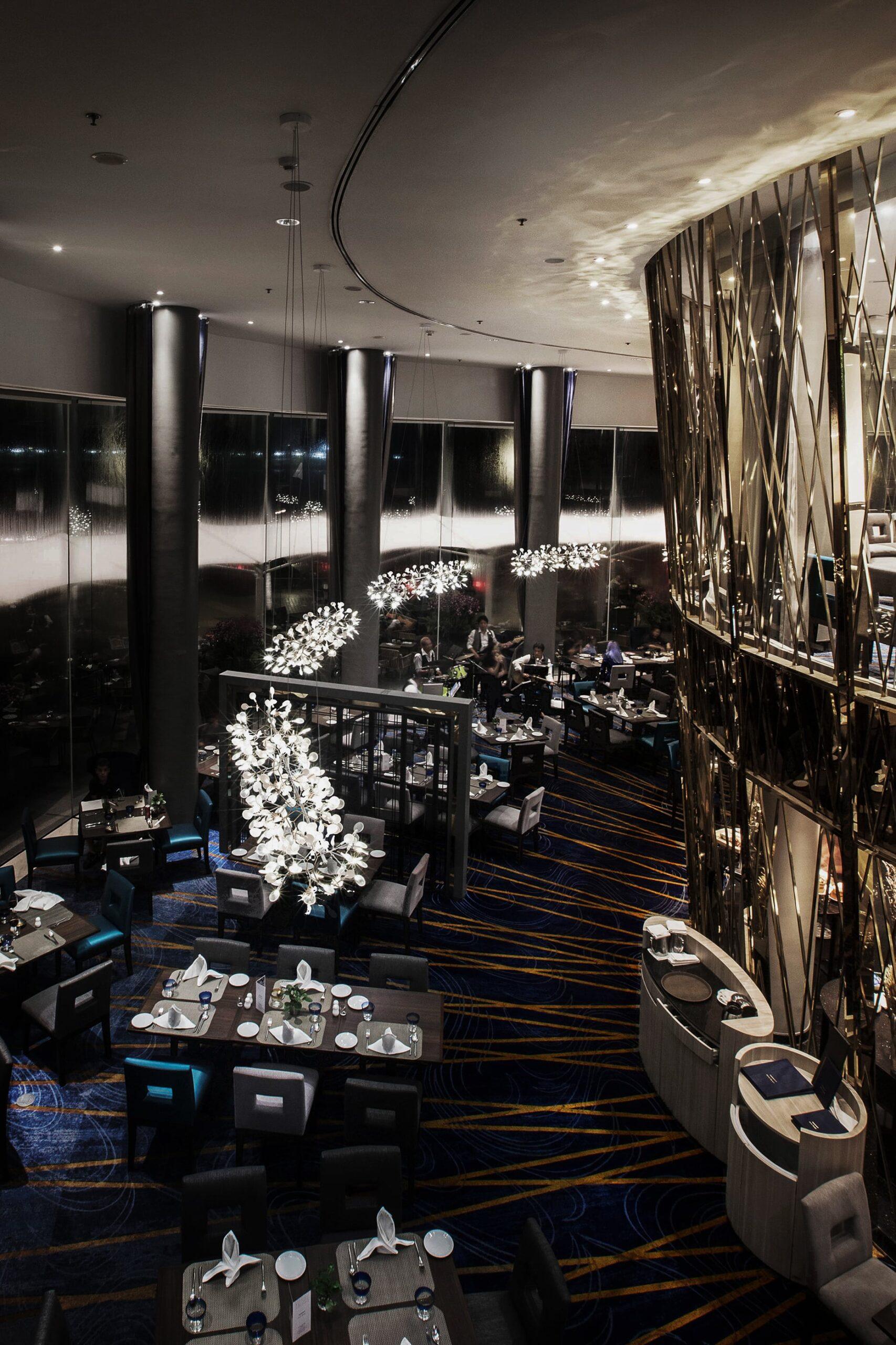
That’s ITH’s Perspective on Being a Design Partner
At That’s ITH Interior, we do not see the role of a hotel interior designer as simply delivering a defined collection of drawings.
We see the role as protecting the identity of the project as it moves from an idea into a real building.
That means asking difficult questions early.
Understanding the site before deciding the style.
Designing for the guest while respecting operations.
Knowing when an element deserves investment.
And carrying the underlying idea through increasing layers of technical reality.
We do not believe every project should look recognisably “That’s ITH.”
We believe every project should feel unmistakably itself.
That is why the visual language can change considerably between projects such as the Royal Orchid Sheraton Ballroom, lyf Sukhumvit 8, and Silver Waves at Chatrium Riverside Bangkok.
The project changes.
The audience changes.
The story changes.
What remains consistent is the thinking — and the commitment to carry that thinking from concept toward the built experience.
For us, Fearless Luxury is not a visual formula.
It is the confidence to make a design decision because it is right for that project.
Explore That’s ITH hospitality and interior design projects.
Planning a Hotel or Hospitality Project?
The best time to evaluate a hotel interior design partner is before the major spatial, experiential, and brand decisions have already been fixed.
Led by founder and designer ITH Palach, That’s ITH Interior is a Bangkok-based interior design studio working across hospitality, residential, and commercial projects in Thailand and international markets.
We collaborate with developers, operators, architects, and multidisciplinary consultant teams to translate identity, guest experience, operations, and ambition into distinctive built environments.
Contact That’s ITH Interior to discuss your next hotel, resort, restaurant, or hospitality development.
Frequently Asked Questions
What should I look for when choosing a hotel interior design company?
Look beyond visual style.
Evaluate relevant built experience, design thinking, technical capability, team structure, hospitality knowledge, scope clarity, consultant coordination, and whether the studio can explain how it carries an idea from concept through execution.
What should I ask a hotel interior design company before hiring them?
Ask who will lead the project, what services are included, how technical documentation is handled, how the studio coordinates with architects and operators, how FF&E is managed, how changes and value engineering are approached, and whether you can review relevant built work and representative technical information.
Why is construction documentation important when selecting an interior designer?
Construction documentation translates approved design intent into information that contractors, fabricators, suppliers, and consultants can coordinate and build from.
Strong technical documentation does not guarantee a perfect project, but it is an important indication that a studio can develop ideas beyond the concept stage.
Should I choose a different company for a boutique hotel and a five-star hotel?
Not necessarily.
The important question is whether the company has the relevant experience, team capacity, hospitality knowledge, and systems required for your project’s scale and complexity.
Boutique and large five-star hotels create different design challenges, but a capable studio may work successfully across both.
How should I compare hotel interior design fees?
Compare scope before comparing total fee.
Check which design stages, areas, deliverables, revisions, FF&E services, travel, procurement support, and construction-stage services are included or excluded. A lower fee does not necessarily represent better value if significant services need to be appointed separately later.
Does a hotel interior design company usually handle FF&E procurement?
It depends on the appointment.
Some studios provide FF&E design and specification only, while others also offer procurement, purchasing, logistics, installation, or procurement support. Developers should clarify these responsibilities before signing a contract.
How important is local experience when choosing a hotel interior design company in Thailand?
Local experience can be valuable because it provides familiarity with regional suppliers, craftsmanship, materials, manufacturing, construction practices, and project conditions.
For international developers, the strongest advantage comes from a design partner able to combine that local fluency with international hospitality expectations.
What are the main red flags when choosing a hotel interior design firm?
Potential warning signs include a repetitive portfolio, limited evidence of built work, unclear scope, vague team responsibilities, unrealistic schedules, weak technical capability, unclear FF&E responsibilities, and a design process that begins with style before understanding the site, brand, guest, and operational requirements.
When should a hotel interior design company be appointed?
Ideally, the interior designer should become involved during the early planning or concept stage.
Early involvement allows guest experience, space planning, architectural relationships, operator requirements, brand identity, and interior design to develop together before major decisions become costly or difficult to change.