
Meet ITH PALACH: Design Philosophy, Fearless Luxury & a Point of View Beyond Style
What makes a space truly memorable?
Rare materials?
Perfect proportions?
An extraordinary piece of furniture?
Or something harder to photograph — a feeling that the place could not have existed in quite the same way for anyone else?
For ITH PALACH, founder and Creative Director of THAT’S ITH INTERIOR, this is where meaningful design begins.
Not with style.
With identity.
Who is this place for? Why does it exist here? What should people feel inside it? And what would make it impossible to confuse with somewhere else?
These questions have shaped a design career spanning more than 25 years and a body of work across luxury hospitality, private residences, restaurants, workplaces, and lifestyle environments in Thailand and international markets.
In 2026, this human-first perspective was recognised by Home Journal, which selected ITH PALACH for its Top 50 SEA 2026 and profiled him under the title “The Room is Not The Protagonist; The Human Being Is.” The feature focused not simply on the appearance of his work, but on a design philosophy built around people’s lives, rituals, emotion, and the belief that true luxury comes from specificity. Home Journal
That philosophy increasingly defines both ITH PALACH and THAT’S ITH:
Fearless Luxury.
Not luxury as excess.
Not luxury as a recognisable look.
But luxury as the confidence to make decisions specific enough that they could not have belonged equally well to somebody else.

Who Is ITH PALACH?
ITH PALACH is the founder and Creative Director of THAT’S ITH INTERIOR, the Bangkok-based design studio he founded in 2013 after building more than two decades of professional design experience.
His work moves across very different scales and typologies.
Hotels.
Restaurants.
Luxury residences.
Villas.
Penthouses.
Workplaces.
Social spaces.
Yet the objective is deliberately not to make them look as though they came from the same designer.
For ITH, a recognisable style can become a limitation when it begins to overpower the identity of the project.
A hotel should reveal something about its destination.
A restaurant should understand the behaviour, food, and people that give it life.
A workplace should express the organisation behind it.
A private home should reveal its owner more clearly than it reveals its designer.
The consistency is not in the aesthetic. It is in the judgment.
That idea has become increasingly central to ITH PALACH’s work.
It is also what separates a design signature from a design point of view.
The Room Is Not the Protagonist
One idea perhaps explains ITH PALACH’s current thinking more clearly than any particular aesthetic:
The room is not the protagonist. The human being is.
A beautifully designed space is ultimately a setting for something else to happen.
A conversation.
A meal.
A morning ritual.
A family gathering.
A moment of solitude.
A guest arriving somewhere unfamiliar.
A person returning home after a difficult day.
This shifts the designer’s attention away from objects alone and toward the emotional and behavioural consequences of design.
How does light affect someone’s rhythm?
What makes one corner feel safe?
Why do people naturally gather in one place and avoid another?
When should a room stimulate?
When should it disappear?
What does comfort mean to this particular person?
In its 2026 profile, Home Journal highlighted precisely this aspect of ITH PALACH’s work: rather than beginning with trend forecasts, the approach searches for clues in how clients actually live and the rituals that matter to them. Home Journal
That distinction is important.
A room can be extraordinary and still fail the person inside it.
For ITH, the more interesting achievement is when architecture, material, light, furniture, technology, and atmosphere quietly conspire to make human experience better.
Design Is Not Decoration — It Is Narrative
ITH PALACH approaches interior design as a form of narrative.
But narrative does not necessarily mean putting a literal story onto the walls.
It can exist in sequence.
Light.
Material.
Scale.
Sound.
Movement.
Privacy.
Contrast.
Anticipation.
The way one room prepares you emotionally for the next.
In hospitality, the narrative might begin before a guest enters the lobby.
In a restaurant, it may continue from arrival to table, bar, restroom, and departure.
In a home, narrative can be quieter.
It might exist in the relationship between a family and the objects they have kept for decades.
In the tension between wanting to entertain and wanting to disappear.
Or in the way a particular room supports a ritual that matters only to the person living there.
Design is not decoration when every decision has a reason.
Without that reason, even beautiful spaces can become interchangeable.
With it, design begins to feel authored.
Fearless Luxury: Luxury Without a Formula
Luxury has traditionally been associated with rarity.
Rare stone.
Limited objects.
Recognised furniture.
Exceptional craftsmanship.
Expensive finishes.
These things can still matter.
But ITH PALACH believes the more interesting definition of rarity today is changing.
When almost anything can be sourced, copied, referenced, photographed, or reproduced, another form of rarity becomes more valuable:
specificity.
A material can be bought.
An object can be collected.
A reference can be reproduced.
But a life cannot.
This position was also articulated in Home Journal’s Top 50 SEA 2026 profile, where ITH described the highest form of luxury as something that could belong only to its owner rather than simply something expensive. Home Journal
That is why Fearless Luxury is not a decorative style.
It is a way of making decisions.
Sometimes fearless means being expressive.
A dramatic ceiling.
A saturated room.
A theatrical arrival.
An unexpected object.
Sometimes it means doing less.
Allowing a view to dominate.
Removing an unnecessary gesture.
Letting one meaningful object carry the emotional weight of an entire room.
Fearless does not always mean louder. It means being certain enough to choose what the project genuinely needs.
And luxury does not come from the quantity of expensive decisions.
It comes from the precision of the right ones.
Fearless. Emotion. Refined.
Three ideas increasingly describe the design territory around ITH PALACH’s work:
Fearless. Emotion. Refined.
Fearless is the willingness to avoid the expected answer.
Emotion is the recognition that people rarely remember spaces as technical compositions. They remember how those spaces made them feel.
Refined is the discipline that prevents boldness from becoming noise.
These ideas can coexist.
A project can be theatrical and controlled.
Personal and sophisticated.
Emotionally expressive without becoming sentimental.
Highly detailed without needing to show every detail at once.
This balance matters because design becomes weaker when everything asks for attention.
Everything cannot be the protagonist.
Some moments need impact.
Others need silence.
Knowing the difference is part of the designer’s role.

Designing From Identity, Not From Style
Interior projects often begin with reference images.
Contemporary.
Minimal.
Modern classic.
Tropical.
Timeless.
Luxury.
These descriptions can be useful.
But they do not yet describe a life, a brand, or a place.
Two clients may both say they want a contemporary home while having completely different relationships with privacy, entertaining, art, family, technology, or comfort.
Two hotels may both position themselves as luxury while serving completely different guests.
Two restaurants can occupy similar price points while needing completely different emotional identities.
ITH PALACH therefore begins further underneath the visual brief.
Who are the people?
What behaviour should the space support?
What contradictions exist?
What should the architecture amplify?
What should it conceal?
What does the site contribute?
What should still matter five or ten years from now?
The interesting part of a brief is sometimes the contradiction, not the preference.
A person may love entertaining but crave absolute privacy.
A couple can share a home without sharing the same definition of comfort.
A hotel may want strong social energy while needing guestrooms that feel almost completely removed from it.
These tensions are not necessarily problems to eliminate.
They are often where the most original design ideas begin.
Why Different Projects Should Look Different
One of the easiest ways for a designer to become recognisable is to repeat.
The same palette.
The same furniture language.
The same decorative gestures.
The same mood.
That can create immediate brand recognition.
ITH PALACH is interested in another kind of consistency.
A consistency of thinking.
Consider several very different THAT’S ITH projects.
lyf Sukhumvit 8 Bangkok translates collective urban memory and social behaviour into an energetic hospitality environment.
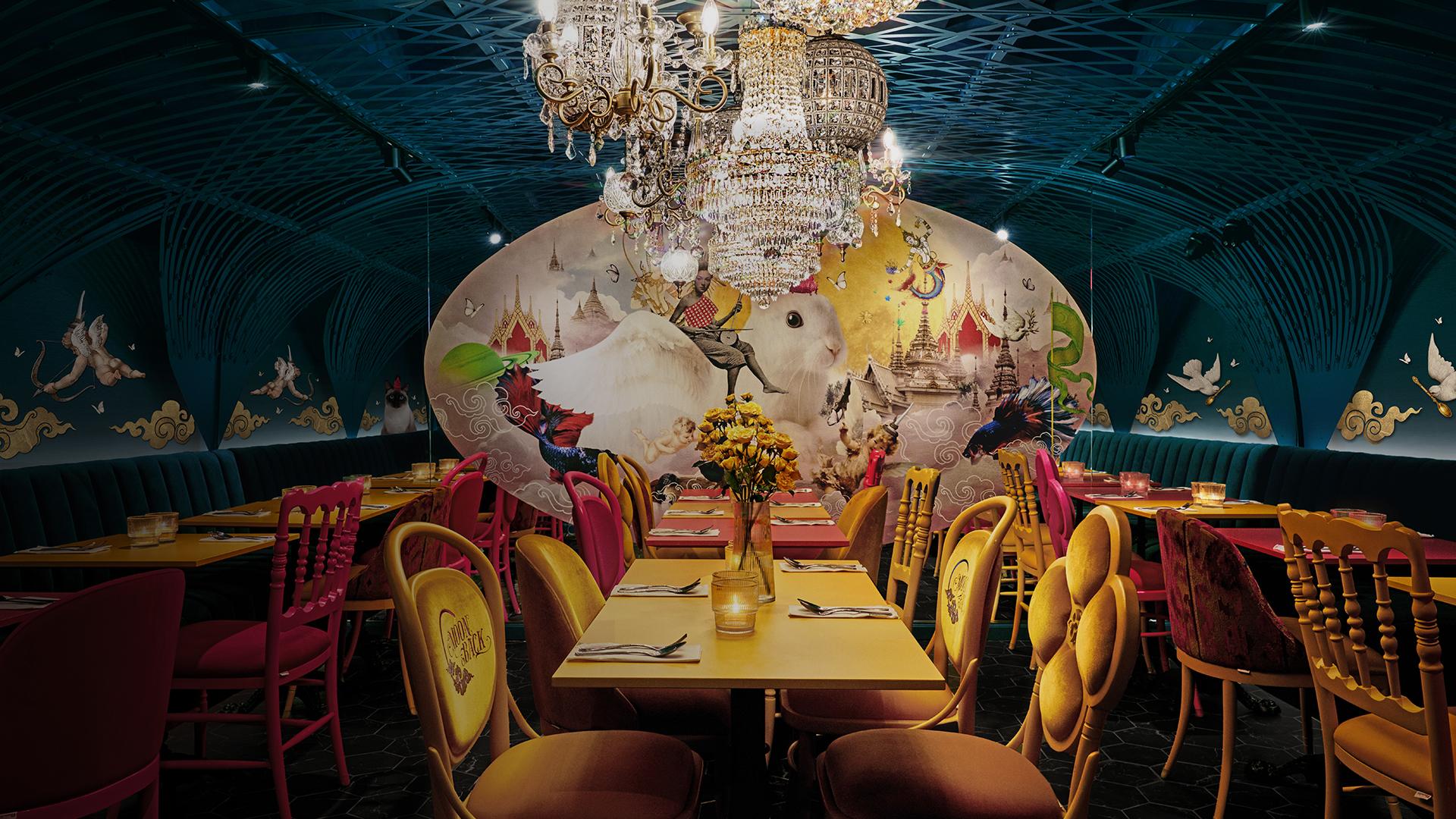
MOON & BACK in New York draws from Thai cultural memory and the identity of a Thai woman raised abroad, while deliberately placing those references within the independent energy of Greenwich Village rather than reproducing a conventional Thai restaurant.
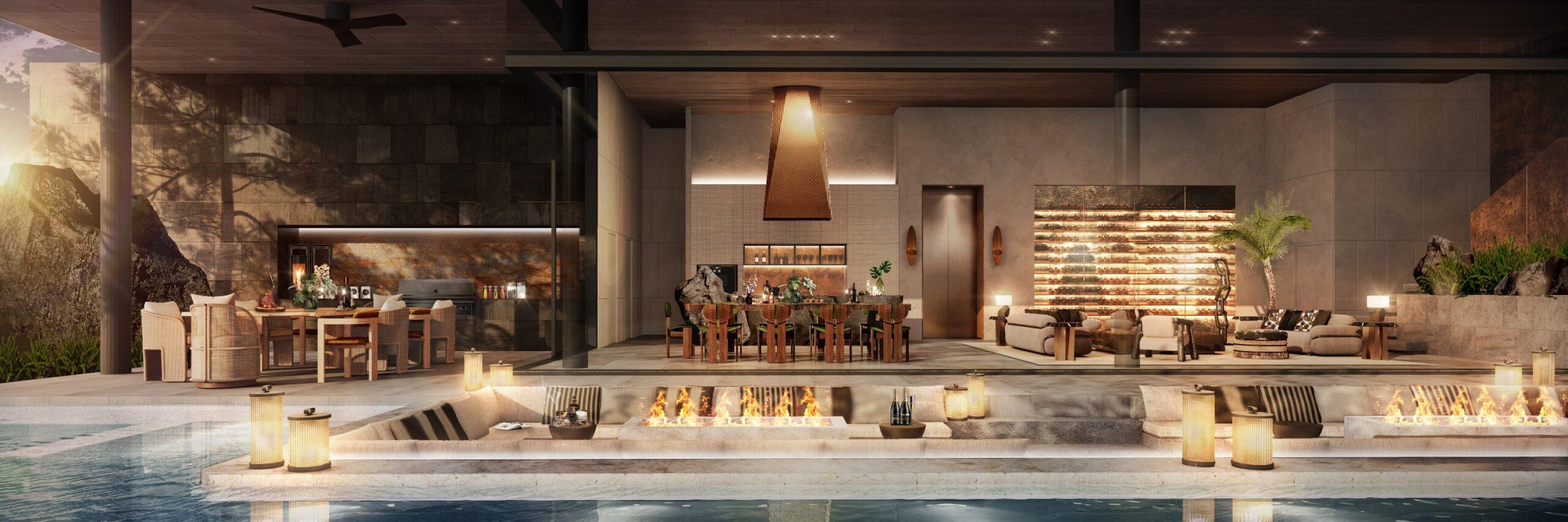
ANANN Villas in Phuket responds to landscape, microclimate, privacy, and the experience of living close to nature.
Hyde Heritage Thonglor – The Elite Collection explores another form of luxury entirely, rooted in highly considered residential detail.
Scope Penthouse moves between two emotional identities — daylight warmth and greenery on one side, and a darker, mirrored, sensual world after dark.
They should not look alike.
They were never intended to.
The project changes. Therefore the answer changes.
What connects them is not a palette.
It is the expectation that every design decision has to earn its place.

Bespoke: When Rarity Becomes Specificity
The idea of bespoke is important to ITH PALACH’s approach to luxury.
But bespoke does not mean making everything custom.
That can become another form of excess.
A bespoke element is most meaningful when an existing solution cannot answer the project precisely enough.
A dining table may respond to the way one family gathers.
A ceiling may exist only because of the volume, owner, and emotional ambition of one particular house.
A piece of furniture may carry an inherited memory.
A reception object might express the entire identity of a hotel in one gesture.
The question is not, “How much can we customise?”
It is:
“What deserves to exist only once?”
The answer may be something large.
Or almost invisible.
That is why bespoke design is ultimately less about manufacturing and more about judgment.
Uniqueness without a reason is simply uniqueness.
Specificity gives it meaning.
Designing Places People Remember
A central idea in ITH PALACH’s current design thinking is Designing Places People Remember.
People rarely remember every square metre of a hotel.
They remember arrival.
A particular light.
A strange transition.
The first view.
The table where something happened.
The room where they finally felt alone.
The experience of a place becomes a collection of emotional fragments.
This is especially important in hospitality.
A property may satisfy every technical requirement and still become forgettable if nothing within the experience forms a meaningful memory.
But memorability does not require constant spectacle.
In fact, too many designed moments can weaken one another.
Memory needs hierarchy.
One moment may deserve drama.
Another may require calm.
The designer’s responsibility is partly to decide which moments are worth carrying forward in someone’s mind.
That is why THAT’S ITH does not define memorable design as simply photogenic design.
A social-media image can create attention.
A meaningful experience creates attachment.
The Human Behaviour Behind Design
ITH PALACH’s thinking has increasingly expanded beyond the traditional boundaries of interior design.
In talks, lectures, and public conversations, the starting point is often not:
“What does the room look like?”
It is:
“What is the human behaviour underneath it?”
Why do people behave differently in hotels from the way they behave at home?
Why can a beautifully designed environment make us slow down?
Why does privacy sometimes feel more luxurious than space?
Why do we continue adding things when editing could make something more valuable?
Why do certain spaces become part of our identity?
This human-first approach also shapes how ITH speaks about design to audiences outside the profession.
Interior design becomes a lens through which to discuss:
identity,
status,
memory,
technology,
wellbeing,
behaviour,
choice,
and the way people construct their lives.
The space matters.
But the person inside it matters more.
That idea now has external editorial validation as well. Home Journal’s 2026 feature positioned ITH PALACH around this same human-centred proposition, describing the designed environment as the stage rather than the central character. Home Journal
Identity: The Designer’s Signature Is Not a Look
ITH PALACH frequently returns to identity — both in design and in personal branding.
For younger designers especially, the pressure to “find a style” can be misleading.
Identity rarely appears because someone decides to repeat one visual language.
It emerges through repeated choices.
What do you say yes to?
What do you repeatedly reject?
Which problems interest you?
Which compromises are you unwilling to make?
What do you notice that other people overlook?
Over time, these decisions reveal a point of view.
Identity is not created by trying to make everything look the same. It is revealed by understanding why you keep choosing certain things differently.
This principle applies equally to a designer, a brand, or a home.
A signature is strongest when people recognise the thinking before they recognise the styling.
The End of Average
Modern tools make good-looking work increasingly accessible.
References travel instantly.
Artificial intelligence can generate hundreds of convincing interior images in minutes.
Products can be sourced globally.
Aesthetic literacy is no longer scarce.
This changes the value of the designer.
If producing another beautiful image becomes easier, then beauty alone cannot remain the primary competitive advantage.
The value moves upstream — toward judgment.
What problem deserves solving?
Which idea is worth developing?
What should be ignored?
Why does this choice belong?
What has emotional meaning?
What is merely fashionable?
What can AI imitate — and what still requires human understanding?
For ITH PALACH, the future of design is therefore not about competing with technology at producing more options.
It is about becoming better at deciding which option deserves to exist.
When average becomes easier to produce, specificity becomes harder to replace.
Interior Design in the Age of AI
Artificial intelligence is already changing how interiors can be visualised.
Images that once required significant time and technical skill can now be generated almost instantly.
For ITH PALACH, that does not necessarily reduce the importance of the designer.
It changes where the value lies.
The designer’s role cannot simply be:
“I can show you something beautiful.”
Technology can increasingly do that.
The more meaningful role is:
“I can understand what should be beautiful, why it should exist, who it should serve, and what should survive when the image becomes a real building.”
AI can generate possibilities.
But a project still needs judgment.
Context.
Responsibility.
Empathy.
Technical reality.
The ability to understand contradiction.
And the willingness to make a decision.
This is why the future designer may become less valuable as an image-maker and more valuable as an editor, strategist, storyteller, and interpreter of human need.
The end of average may not be the end of designers. It may be what forces design to become more human again.

From Biophilic Design to Longevity
ITH PALACH’s thinking about wellbeing has also moved beyond the idea of simply placing more nature inside buildings.
Biophilic design has helped reinforce the importance of people’s relationship with the natural world.
But contemporary conversations around wellness and longevity ask a wider question:
How does the environment affect the body repeatedly, every day?
Light influences circadian rhythm.
Sound affects rest.
Heat and airflow change comfort.
Privacy affects psychological recovery.
Material tactility influences sensory experience.
The quality of sleep may be shaped by decisions made long before someone enters a wellness retreat.
This leads to a broader understanding of longevity design.
Not as a stylistic movement.
Not as a collection of health gadgets.
But as the accumulation of ordinary environmental decisions that can support better living over time.
The future of wellbeing may therefore be less about designing one designated wellness room.
It may be about making the entire environment more intelligent toward the human body.
This direction also aligns with ITH’s broader belief that as environments and technology become more intelligent, they should become more human, not less — a perspective highlighted in his Home Journal Top 50 SEA 2026 interview. Home Journal
Hospitality: From Destination to Behaviour
ITH PALACH’s work and talks around hospitality often begin with a simple observation:
People behave differently when they travel.
They may wake earlier for hotel breakfast.
Wear a robe they would never wear at home.
Take longer showers.
Sit beside a pool doing almost nothing.
Talk to strangers.
Order something at breakfast they would never cook for themselves.
Travel temporarily gives people permission to behave differently.
This creates an interesting responsibility for hotel designers.
A hotel does not simply contain the trip.
Sometimes the environment helps create the version of ourselves we become while travelling.
That means hospitality design should not be reduced to lobby, restaurant, and guestroom aesthetics.
It can shape:
ritual,
social behaviour,
privacy,
discovery,
celebration,
and memory.
This is why Designing Places People Remember is not simply a hospitality tagline.
It describes an ambition to design around what people eventually carry home with them.
A Designer’s Role Is Also to Know When to Say No
Good design does not come from saying yes to every possibility.
More material.
More furniture.
More lighting.
More bespoke details.
More features.
More technology.
More visual impact.
Eventually, abundance can weaken intention.
ITH PALACH sees editing as part of design authorship.
A designer should understand what needs to disappear for another idea to become stronger.
This also applies to client relationships.
The designer’s responsibility is to listen deeply.
But listening does not mean agreeing automatically.
Sometimes professional judgment means saying:
There is a better solution.
Not because the designer needs to win.
But because a decision may compromise:
proportion,
comfort,
function,
longevity,
identity,
or the larger idea.
A good designer should not simply give a client what they ask for.
They should understand what the client is really trying to achieve — and help them reach it more intelligently.
Creative Freedom Needs Technical Discipline
A bold idea that cannot survive construction is not a finished idea.
ITH PALACH’s approach to design therefore connects creative ambition with technical responsibility.
Bespoke pieces have to be fabricated.
Materials need to perform.
Lighting has to integrate with architecture.
Operations must work.
Drawings must communicate.
Budgets change.
Site conditions intervene.
Value engineering happens.
The challenge is not to prevent every change.
It is to recognise which elements are flexible and which carry the core identity of the project.
Protecting design intent does not mean refusing change. It means knowing what the project cannot afford to lose.
That distinction becomes especially important in large residential and hospitality projects, where hundreds of practical decisions accumulate between concept and completion.
The designer’s task is not only to create the idea.
It is to protect its meaning while allowing it to become real.
Recognition Without Designing for Recognition
ITH PALACH and THAT’S ITH have received recognition across international design and property platforms.
Recent achievements include two Global Winner distinctions at the International Property Awards for The Address Siam–Ratchathewi and Hyde Heritage Thonglor – The Elite Collection, alongside multiple honours at the Asia Pacific Property Awards 2026–2027.
lyf Sukhumvit 8 Bangkok received DEmark 2025 recognition.
In 2026, Home Journal selected ITH PALACH for Top 50 SEA 2026, placing his work and philosophy within its selection of notable designers in Southeast Asia. Significantly, the editorial profile did not position him around one signature aesthetic. Its central theme was human experience: “The Room is Not The Protagonist; The Human Being Is.” Home Journal
That distinction matters because it reflects how ITH PALACH increasingly wants the work to be understood.
Not simply as a collection of award-winning interiors.
But as a body of thinking about people, identity, emotion, and the role design plays in their lives.
ITH PALACH’s wider professional role also increasingly includes speaking, judging, and contributing to design conversations across the region.
He has been invited to participate in international and regional design forums, award juries, industry events, and university lectures — discussing subjects ranging from identity and personal branding to artificial intelligence, hospitality, luxury, biophilic design, longevity, and the future role of the designer.
These activities reflect a broader ambition.
Not simply to produce projects.
But to contribute a point of view about where design is going.
Awards and recognition remain meaningful.
But they are evidence, not the objective.
Recognition should follow work worth recognising — not become the reason the work exists.
From Designer to Cultural Point of View
For ITH PALACH, design is increasingly connected to a wider conversation about culture.
Why do people desire certain things?
Why does one version of luxury become desirable while another disappears?
How does technology alter behaviour?
Why do people remember one place and forget another?
How do environments affect identity?
These questions extend beyond interiors.
And that is intentional.
A designer today operates inside a culture shaped by:
media,
brands,
technology,
travel,
economics,
status,
entertainment,
and rapidly changing ideas of aspiration.
Understanding those forces can make design more intelligent.
It can also make a designer’s point of view relevant beyond the design industry itself.
The goal is not simply to make a designer more visible.
It is to make the point of view more culturally relevant — and allow that relevance to make the work more valuable.

What ITH PALACH Believes the Future of Luxury Looks Like
The future of luxury may contain extraordinary objects.
But objects alone will become easier to acquire.
Luxury may contain advanced technology.
But the best technology will increasingly disappear into the environment.
It may involve wellness.
But wellbeing will move beyond dedicated amenities into the way entire spaces support ordinary life.
And it will certainly involve personalisation.
But personalisation will need to go deeper than selecting finishes from a menu.
The more standardised the world becomes, the more valuable specificity may become.
That leads back to the central idea behind ITH PALACH’s work.
Luxury is not about having what very few people can buy.
Increasingly, it may be about creating something that would not make complete sense for anyone else.
A home shaped around one life.
A hotel inseparable from its destination.
A restaurant whose identity could not simply be transplanted to another city.
A workplace that reveals something true about the organisation inside it.
This is where Fearless Luxury becomes less about appearance and more about authorship.
Designing Places People Remember
Ultimately, the ambition is simple.
Not simple to achieve — but simple to state.
Design places people remember.
Not because every room demands attention.
Not because everything is expensive.
Not because the designer has imposed a signature.
But because enough of the decisions belong so precisely to the people, place, and moment that the result becomes difficult to confuse with anything else.
For ITH PALACH, that is where design becomes personal.
Where luxury becomes meaningful.
And where a space stops being merely beautiful and begins to possess identity.
Fearless. Emotion. Refined.
Not as three decorative styles.
As three ways of making decisions.
And perhaps the most important question remains the same one that began the conversation:
What could exist here that could not have existed in quite the same way anywhere else?
Work With ITH PALACH and THAT’S ITH INTERIOR
THAT’S ITH INTERIOR works across luxury hospitality, private residential, villa, penthouse, restaurant, workplace, and lifestyle projects in Thailand and international markets.
The studio does not begin by asking clients which THAT’S ITH project they want their project to resemble.
It begins by understanding the identity that does not yet exist anywhere else.
For clients, developers, and collaborators, that means the relationship is not simply about selecting a visual style.
It is about developing a point of view strong enough to survive from the first conversation to the built environment.
Contact THAT’S ITH INTERIOR to begin a conversation with the studio.
You do not need to arrive with the perfect answer.
The right question is often where the project begins.
Related Articles
- The Story Behind THAT’S ITH: Fearless Luxury, Human Experience and Design Without a Formula
- What Makes an Award-Winning Interior Designer?
- High-End Interior Designer Thailand: What Defines the Right Expert for Luxury Projects?
- Interior Design Bangkok: The Complete Guide to High-End Interiors in Thailand